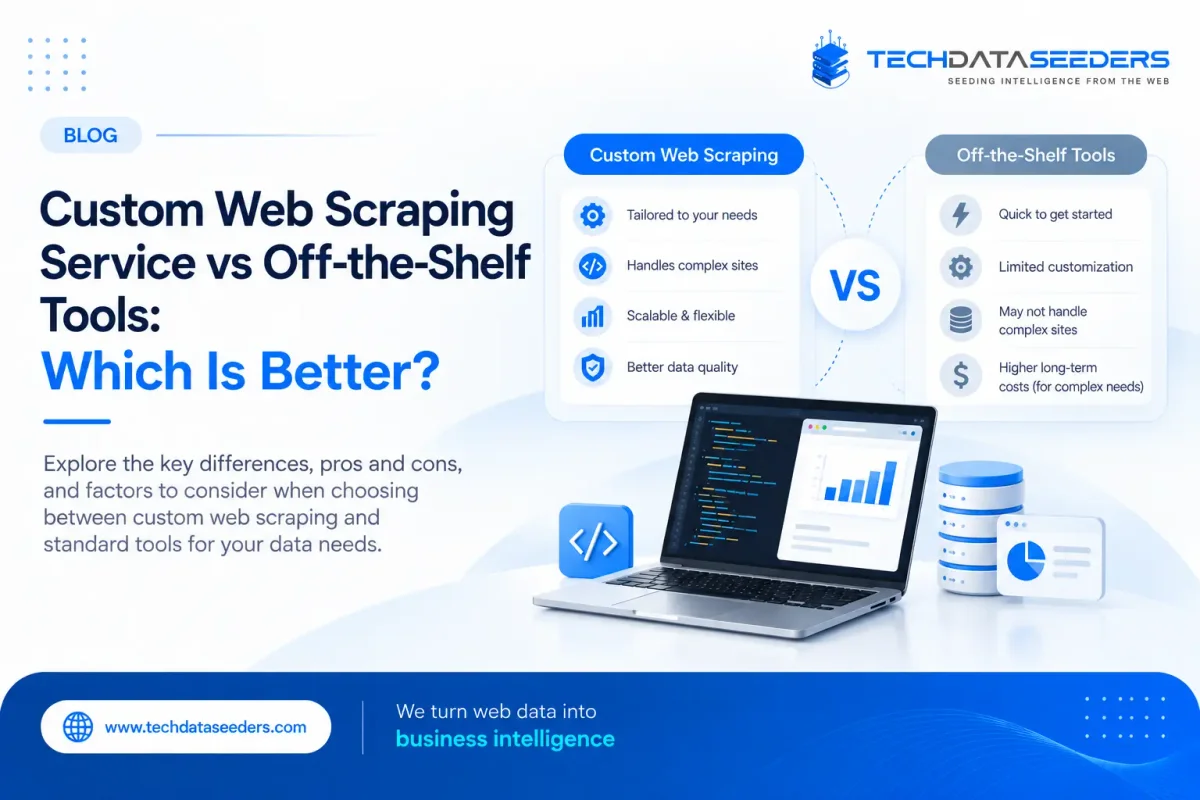
Custom Web Scraping Service vs Standard Tools: What's the Difference?
The simplest way to understand the difference is to look at control versus convenience.
Standard Web Scraping Tools are generally designed to provide ready-made functionality. You select a website or configure a scraper, define some basic rules, and collect the available data.
Custom data extraction Services are built around your specific requirements. The extraction logic, fields, workflows, data formats, schedules, and integrations can all be designed around the project.
Here's a quick comparison:
| Factor | Custom Web Scraping Service | Off-the-Shelf Tools |
|---|---|---|
| Setup | Requires development | Usually faster |
| Flexibility | Highly customizable | Limited to available features |
| Complex websites | Can be designed specifically for them | Depends on tool capabilities |
| Data fields | Custom fields possible | Predefined/configurable |
| Scaling | Designed around your workload | Depends on platform |
| Integrations | Can be customized | Usually predefined |
| Maintenance | Managed according to requirements | Often handled by the user/tool |
| Cost | Higher initial investment | Usually lower entry cost |
| Best for | Complex, recurring requirements | Simple or smaller projects |
Neither option is automatically better.
The right choice depends on the complexity and long-term value of the data you need.
What Are Standard Web Scraping Tools?
Standard Web Scraping Tools are ready-made platforms or applications that allow users to extract information from websites without developing a scraper from scratch.
Many are designed to be accessible to non-developers and may provide visual interfaces, browser extensions, templates, scheduling, and basic data export options.
They can work well when you need to:
- Collect a small dataset
- Extract information from a relatively simple website
- Run a one-time research project
- Test whether a data source is useful
- Avoid writing code for a basic scraping task
For example, if a researcher needs a few hundred product listings from a relatively stable website, a standard tool may do the job perfectly well.
The problem starts when the requirements go beyond what the tool was designed to handle.
What Is a Custom Web Scraping Service?
Custom Web Scraping Service involves developing an extraction workflow specifically around a business's data requirements.
Instead of adapting your requirements to an existing tool, the scraping system is designed around the sources, fields, frequency, volume, and output format you actually need.
A custom workflow can include:
- Website-specific extraction logic
- Dynamic content handling
- JavaScript rendering
- Pagination
- Proxy management
- Automated retries
- Data validation
- Deduplication
- Scheduled extraction
- Custom data transformation
- API integration
- Database delivery
This makes Custom Web Scraping Service particularly useful when web data is an ongoing business requirement rather than a one-time research task.
Custom Web Scraping Solutions Offer More Flexibility
One of the biggest advantages of custom web scraping solutions is flexibility.
With an off-the-shelf platform, you're generally working within the features and limitations provided by the tool.
A custom solution can be designed around your exact requirements.
For example, an e-commerce company may want to collect:
Product Name → Brand → Price → Discount → Availability → Rating → Reviews → Product URL
But it may also want different extraction rules for different websites.
A custom scraper can account for those differences rather than forcing every source into the same template.
This becomes especially valuable when websites have different layouts, naming conventions, navigation structures, or dynamic elements.
Custom Data Scraping Solutions for Complex Requirements
Businesses often need more than basic page extraction.
Custom data scraping solutions can be built for specific use cases such as:
- Competitor price monitoring
- Market research
- Real estate data collection
- Product intelligence
- Lead generation
- Travel data monitoring
- Financial research
- Business directory extraction
- News monitoring
For example, a property company might need listings from several real estate websites.
Each website could have different fields, page structures, filters, and pagination systems.
Rather than maintaining separate manual workflows, a custom system can normalize information from different sources into one consistent dataset.
That means your internal team receives data in a format they can actually use.
Custom Scrapers vs Ready-Made Scraping Tools
The difference between Custom scrapers and ready-made tools becomes more obvious when you look at maintenance and control.
A standard tool may work perfectly today but struggle when a website changes its HTML structure.
With custom scrapers, custom web scraping architecture logic can be specifically designed for the target source and updated when the source changes.
Custom development can also account for requirements such as:
- Specific CSS or XPath selectors
- Complex page navigation
- Dynamic rendering
- Multiple extraction patterns
- Custom error handling
- Data transformation
- Website-specific rules
This doesn't mean custom scrapers never break.
Websites change, APIs change, and access conditions change. The advantage is that the scraper can be maintained around your actual requirements instead of being limited by the capabilities of a generic platform.
Custom Web Scraping vs Standard Tools for Scalability
A scraper that works for 1,000 pages may not be suitable for 10 million pages.
This is where scalability needs to be considered from the beginning.
With Custom Web Scraping, the architecture can be designed around expected data volumes.
Depending on the project, this could involve:
- Parallel processing
- Request queues
- Distributed crawling
- Proxy rotation
- Automated retries
- Cloud infrastructure
- Scheduled jobs
- Monitoring systems
- Centralized data storage
Off-the-shelf platforms may also offer scalability, but you're limited to the infrastructure, request limits, concurrency, and pricing structure of the provider.
If your data requirements are expected to grow significantly, it's worth evaluating this before choosing a tool.
When Should You Choose Standard Web Scraping Tools?
An off-the-shelf tool can be the better option when simplicity is more important than customization.
Consider a standard tool if:
- You have a small data requirement
- You need data only once
- The target website is relatively simple
- You don't need complex integrations
- Your data fields are straightforward
- Your team doesn't have development resources
- You want to test a data collection idea quickly
For these situations, building a custom system could introduce unnecessary cost and development time.
If a ready-made tool solves the problem reliably, there's no reason to make the project more complicated.
When Is Custom Web Scraping a Better Choice?
Custom Web Scraping becomes more attractive when your data requirements are complex, recurring, or business-critical.
You may want a custom solution if:
- You need data from multiple websites
- Each source has a different structure
- You require specific data fields
- Data needs to be collected regularly
- You need large-scale extraction
- Your data needs to connect with internal systems
- Standard tools can't handle the required websites
- You need custom processing or validation
- Your team spends too much time fixing scraping workflows
A useful rule is this:
If the data collection process needs to adapt to your business, rather than your business adapting to the tool, custom scraping is worth considering.
Custom vs Off-the-Shelf Scraping Tools: Cost Comparison
Cost is often one of the first things businesses consider.
At first glance, off-the-shelf tools usually appear cheaper. You may pay a monthly subscription and start collecting data immediately.
Custom scraping can require a larger initial investment because development, infrastructure, testing, and maintenance need to be considered.
But the cheapest option upfront isn't always the cheapest over time.
Consider the total cost of ownership, including:
- Development
- Tool subscriptions
- Proxy costs
- Infrastructure
- Data storage
- Maintenance
- Developer time
- Failed extraction jobs
- Data quality issues
- Integration work
For a small project, a standard tool will often make more financial sense.
For a large, recurring data operation, a custom solution may provide better long-term value because it is built specifically around the business workflow.
Data Quality and Accuracy: Which Approach Wins?
Data quality depends less on whether a scraper is "custom" or "standard" and more on how the entire extraction workflow is designed.
However, custom solutions can provide greater control over quality checks.
For example, a custom pipeline can include rules for:
- Required fields
- Duplicate detection
- Data type validation
- Missing values
- Price formatting
- Category normalization
- Record matching
- Outlier detection
This can be particularly important when scraped data feeds directly into analytics, pricing systems, or business intelligence platforms.
A standard tool can still produce high-quality data for simple use cases. But when your dataset has strict requirements, customization gives you more room to build the necessary validation into the workflow.
Integration and Data Delivery
Another important consideration is what happens after the data is scraped.
If the final output is simply a CSV file downloaded once a month, an off-the-shelf tool may be enough.
But what if the data needs to flow directly into your application?
A custom solution can be designed to deliver data through:
- APIs
- Databases
- Cloud storage
- JSON
- CSV
- XML
- Data warehouses
- Custom pipelines
This makes Custom Web Scraping particularly useful for businesses that want web data to become part of an existing technology stack rather than remaining in a separate spreadsheet.
Maintenance: Who Handles the Scraper When Websites Change?
Web scraping isn't a "build it once and forget it" process.
Websites redesign pages, change HTML structures, introduce new JavaScript components, modify URLs, robots.txt and crawling guidelines or alter how information is loaded.
With an off-the-shelf platform, you're generally dependent on the tool provider's ability to support those changes.
With custom scrapers, maintenance can be managed according to your requirements.
A proper maintenance workflow should include:
Monitoring → Error Detection → Scraper Updates → Testing → Data Validation
This is especially important for businesses relying on daily or hourly data collection.
How to Decide Between Custom Web Scraping and Off-the-Shelf Tools
Still unsure?
Use your project requirements as the deciding factor.
Choose an off-the-shelf tool when:
You need a simple solution, have limited data requirements, and want to get started quickly.
Choose Custom Web Scraping when:
You need complex extraction, recurring collection, multiple sources, custom data structures, large-scale processing, or integration with internal systems.
You should also consider how important the data is to your business.
If scraped data directly influences pricing, competitive intelligence, analytics, or an AI application, reliability and control may matter more than simply minimizing the initial cost.
Custom Web Scraping vs Standard Tools: A Quick Decision Guide
| Your Requirement | Better Option |
|---|---|
| One-time small dataset | Standard tool |
| Simple website | Standard tool |
| Quick proof of concept | Standard tool |
| Multiple complex websites | Custom solution |
| Large-scale recurring extraction | Custom solution |
| Custom data fields | Custom solution |
| API/database integration | Custom solution |
| Advanced validation | Custom solution |
| Business-critical data pipeline | Custom solution |
| Highly specialized workflow | Custom solution |
The goal isn't to choose the most technically sophisticated option.
It's to choose the approach that gives you reliable data without creating unnecessary complexity.
Why Choose Techdataseeders for Custom Web Scraping?
Techdataseeders provides Custom Web Scraping solutions designed around specific business data requirements.
Rather than forcing a project into a standard scraper template, the extraction workflow can be developed around the target sources, required fields, collection frequency, data volume, and delivery requirements.
The process can include data extraction, structured output, validation, monitoring, and integration with downstream systems.
This approach is particularly useful for businesses that have moved beyond simple scraping tools and need a more dependable way to collect recurring web data at scale.
Whether you're monitoring competitors, collecting market data, tracking products, or building a larger data pipeline, the right solution should fit the way your business actually uses data.
FAQs
Custom Web Scraping is built around specific business requirements, while standard scraping tools provide predefined features and workflows for general use cases.
Yes. Standard Web Scraping Tools are often suitable for simple websites, smaller datasets, one-time projects, and quick data collection.
Choose Custom Web Scraping when you need complex extraction, multiple sources, recurring data collection, custom fields, large-scale processing, or system integrations.
They can have a higher initial cost, but they may provide better long-term value for complex or recurring data requirements.
Yes. Custom web scraping solutions can be designed with scalable infrastructure, parallel processing, queues, proxy management, and automated monitoring.
Yes. Custom data scraping solutions can be designed to deliver data through APIs, databases, cloud storage, or other formats compatible with your existing systems.
Neither is universally better. Standard tools are ideal for simple requirements, while Custom vs Off-the-Shelf Scraping Tools becomes a question of flexibility, scalability, maintenance, and long-term business needs.