What Is Web Scraping, and When Does It Make Sense?
Web scraping is an automated method of extracting information from website pages and converting it into structured data for analysis. It is useful when businesses need information that is visible on websites but unavailable through a suitable API. Depending on the source, scraping may involve HTML parsing, browser automation, or extracting embedded structured data.
For example, an ecommerce company might collect competitor product names, prices, ratings, availability, and product URLs from multiple retail websites. The extracted records can then be cleaned, deduplicated, and stored in a database or data warehouse.
When Should a Business Choose Web Scraping?
Choose web scraping when the required information is available on websites, but existing APIs do not provide adequate coverage or access. It is especially useful for competitor price monitoring, product catalogue extraction, review analysis, search result tracking, and market research.
For recurring or large-scale projects, plan for monitoring, retry logic, data validation, change detection, and maintenance from the beginning. These are part of a production scraping workflow, not optional extras.
Web Scraping vs Data API: What Are the Key Differences?
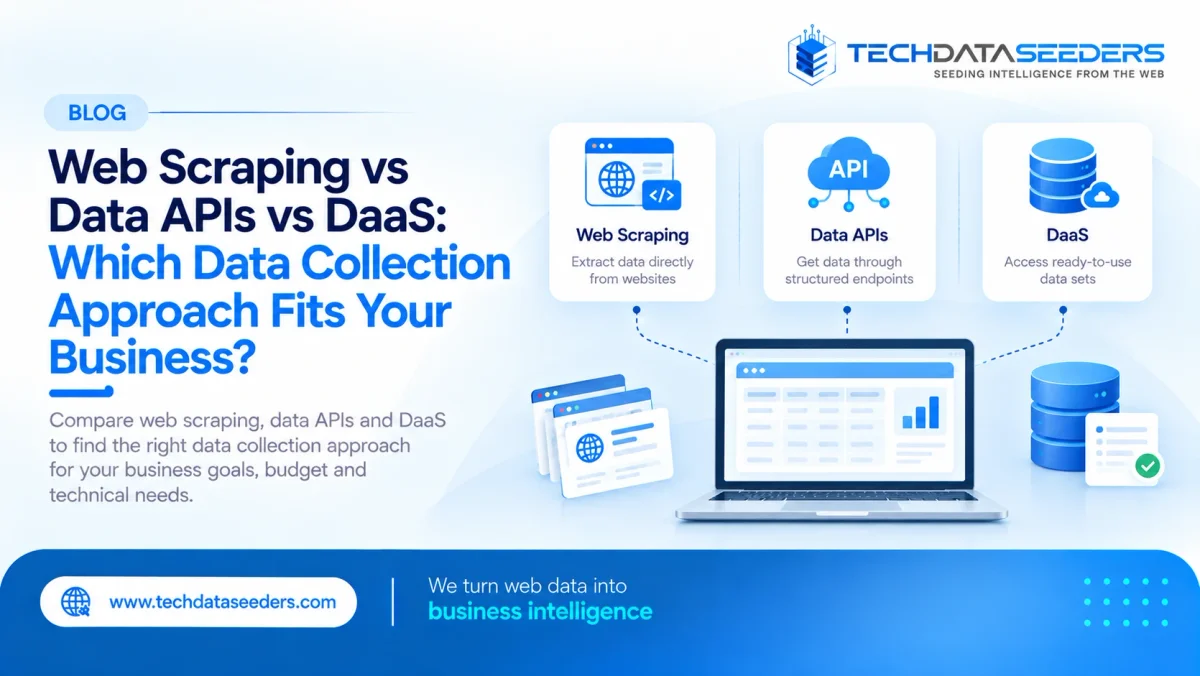
The main difference between web scraping vs data API collection is how the information is accessed. Web scraping extracts content from website pages, while an API provides data through defined endpoints. APIs generally offer more predictable response structures, whereas scraping can capture website-visible information that an API does not expose.
| Comparison factor | Web scraping | Data API |
|---|---|---|
| Access method | Website pages and rendered content | Defined programmatic endpoints |
| Data format | HTML, DOM elements, embedded data | Commonly JSON or XML |
| Data coverage | Depends on accessible page content | Depends on API endpoints and permissions |
| Setup | Extraction rules and parsing logic | API integration and authentication |
| Maintenance | Page structure and rendering changes | Version changes, quotas, and endpoint changes |
| Data limits | Source restrictions and technical constraints | Published or contract-based quotas |
| Best use case | Website-level data collection | Structured access to supported datasets |
Data Availability and Coverage
Web scraping can be more suitable when a website displays information that its API does not expose. An API, on the other hand, may provide additional fields or historical records that are difficult to obtain from public pages.
Consider a product listing that displays a price, seller name, promotional badge, rating, and availability message. If an API exposes only the product name and standard price, scraping may help capture the remaining visible fields, provided collection is permitted.
Reliability and Maintenance
APIs usually provide documented schemas and predictable error responses, making them easier to integrate into stable applications. Web scraping depends on the structure and behavior of the target website, so changes to page layouts, selectors, or rendering can require updates.
However, an API is not maintenance-free. Authentication changes, deprecations, quota restrictions, and changes in the provider's data can still disrupt a pipeline.
Cost and Scalability
The cost comparison depends on volume, access fees, infrastructure, and maintenance effort. An API may be economical for targeted requests, while large-scale collection can become expensive under per-request pricing. Scraping may provide broader coverage but adds engineering, infrastructure, monitoring, and repair costs.
Compare total cost of ownership rather than just the API fee or the initial cost of building a scraper.
Web Scraping vs DaaS: Which Offers More Control?
The difference between web scraping vs DaaS is mainly about operational responsibility. Web scraping is a data extraction technique that a business can build and manage itself or outsource. DaaS is a service model in which a provider supplies data and may manage collection, processing, validation, updates, and delivery.
| Factor | Web scraping | DaaS |
|---|---|---|
| Data collection | Managed internally or outsourced | Usually handled as part of the agreed service |
| Customization | High control over extraction logic | Depends on provider capabilities and contract |
| Infrastructure | Must be managed or purchased | Often managed by the provider |
| Data cleaning | Requires a separate workflow unless included | May be included in the service |
| Maintenance | Internal team or scraping partner | Provider handles agreed responsibilities |
| Delivery | Chosen by the implementation team | API, files, feeds, or other supported methods |
| Best fit | Teams needing control over extraction | Teams needing managed, ongoing data delivery |
When Web Scraping Offers More Control
Building your own web scraping system gives your team direct control over source selection, extraction rules, schemas, collection frequency, and processing logic. That can be valuable when the business has unusual requirements or needs to change its data pipeline frequently.
The trade-off is ownership of the engineering work. Your team must monitor failures, adapt to website changes, manage infrastructure, and verify the accuracy and completeness of collected records.
When DaaS Reduces Operational Work
DaaS is useful when the business wants a maintained dataset without owning every part of the collection process. Depending on the provider, the service can include source monitoring, extraction, normalization, deduplication, quality checks, scheduled refreshes, and delivery into existing business systems.
Before selecting a provider, clarify which responsibilities are included. A DaaS agreement may not guarantee real-time updates, complete source coverage, or a particular quality level unless those requirements are explicitly defined.
Can DaaS Use Web Scraping?
Yes. A DaaS provider can use web scraping, official APIs, licensed datasets, or a combination of sources to produce the final dataset. The customer receives the agreed data output rather than necessarily managing the collection mechanisms.
This distinction matters because web scraping and DaaS are not always competing alternatives. A company can commission a managed data service that uses scraping behind the scenes and delivers the results through an API or scheduled feed.
Data Collection Methods: How to Choose the Right Approach
The best data collection methods are the ones that meet your requirements for coverage, freshness, reliability, compliance, and cost without adding unnecessary complexity. Start by defining the data you need and the decisions it will support, then assess the access method and operational responsibilities required to maintain it.
Use the following decision framework before committing to a solution.
Step 1: Define the Required Data Fields
Write down the exact fields your business needs, such as product ID, price, seller, stock status, review count, timestamp, or location. Check whether the source provides those fields through an API or whether they appear only on its website.
A field-level assessment prevents you from choosing an API that looks suitable but leaves important gaps.
Step 2: Estimate Volume and Update Frequency
Determine how many records you need, how frequently they change, and how quickly your team must receive updates. A daily catalogue refresh has different requirements from monitoring fast-changing prices several times per hour.
Consider request limits, processing capacity, storage, historical retention, and the cost of retrieving unchanged records.
Step 3: Evaluate Technical Resources
Assess whether your team can build and maintain extraction workflows, API integrations, and data quality checks. If your organization already has data engineers and an established pipeline, an internal solution may fit. If operational capacity is limited, a managed service may be more practical.
Step 4: Compare Total Cost of Ownership
Include more than the initial setup or subscription fee. Account for infrastructure, API usage, development, maintenance, data cleaning, monitoring, failure recovery, and the business impact of missing or delayed data.
A lower initial cost does not always mean a lower long-term cost.
Step 5: Check Compliance and Data Rights
Review source terms, access permissions, contractual restrictions, privacy obligations, and applicable laws. Confirm whether the intended collection, storage, redistribution, and commercial use are permitted.
Do this before implementation rather than after the pipeline is already in production.
Step 6: Run a Pilot
Test a representative sample of sources and records before scaling. Measure field completeness, accuracy, freshness, collection success, processing time, and total operating cost.
A pilot helps uncover issues such as inconsistent product identifiers, missing pagination, region-specific results, or unexpected API limits before they affect business decisions.
Can Businesses Combine Web Scraping, APIs, and DaaS?
Yes. Combining web scraping, APIs, and DaaS can provide better coverage and reduce operational overhead when different sources have different access requirements. Businesses can use official APIs for structured data, scraping for permitted website information that APIs omit, and DaaS to manage collection, validation, and delivery across the complete workflow.
For example, an ecommerce analytics team could use:
- Official APIs to retrieve authorized product catalogue information and account data.
- Web scraping to collect additional permitted product-page details from external retail websites.
- DaaS to coordinate collection, normalize product records, validate prices, and deliver the resulting dataset.
- A data warehouse to retain historical observations and support trend analysis.
- BI dashboards or machine learning systems to turn the data into business insights.
The key is to make each component responsible for a clearly defined task. Avoid collecting the same data twice unless redundancy is necessary for validation or reliability.
How Tech Data Seeders Supports Business Data Collection?
Businesses that need data from multiple websites often require more than a basic extraction script. They need a repeatable process for collecting relevant information, handling source changes, checking data quality, and delivering structured records to the systems that use them.
Tech Data Seeders provides web data extraction and automation services for business data needs. Depending on the project requirements, a data collection workflow can include:
- Custom web scraping: Extracting relevant information from selected websites according to defined requirements.
- Data extraction and structuring: Converting collected information into organized records suitable for analysis.
- Data validation: Checking for missing fields, duplicates, inconsistent values, and other quality issues.
- Automated data workflows: Scheduling collection and connecting data outputs with downstream systems.
- Business intelligence support: Preparing structured data for reporting, competitive research, analytics, and other business applications.
The right implementation depends on the source websites, data volume, update frequency, access permissions, and delivery format. Defining these requirements early helps determine whether a custom scraper, API integration, managed data service, or hybrid approach makes the most sense.
Conclusion
Choosing between web scraping vs data APIs vs DaaS starts with understanding what data your business needs and how much responsibility you want to retain for collecting and maintaining it.
Web scraping offers flexibility when suitable APIs cannot provide all the required website information. Data APIs are useful for structured access to supported datasets. DaaS is a strong option when you want a managed supply of data, including agreed collection, processing, and delivery responsibilities.
For many businesses, the most practical solution is a combination of these approaches. Evaluate data coverage, freshness, compliance, maintenance, and total cost before deciding. The goal is not to choose the most sophisticated technology; it is to build a dependable data pipeline that supports better business decisions.
FAQs
Web scraping vs data APIs vs DaaS differs in how data is accessed and delivered. Web scraping extracts information from websites, data APIs provide structured access through defined endpoints, and DaaS delivers data through a managed service. The best option depends on your data requirements, technical resources, and maintenance needs.
Choosing between web scraping vs data API access depends on data availability and flexibility. APIs are suitable when a provider offers the required fields and access permissions. Web scraping is useful when businesses need additional website-visible information that suitable APIs do not provide.
Different data collection methods affect accuracy through source reliability, data freshness, validation, and processing quality. Web scraping vs data APIs vs DaaS should be evaluated based on field completeness, duplicate detection, update frequency, and consistency checks rather than the collection method alone.
Data APIs vs DaaS mainly differs in operational responsibility. An API provides access to specific data endpoints, while DaaS typically supplies prepared datasets through an agreed delivery method. Businesses managing large-scale projects should compare data coverage, refresh schedules, integration requirements, and the level of ongoing support.
Web scraping vs DaaS for competitor price monitoring depends on your team's technical capacity and desired control. Custom scraping offers flexibility over sources and extracted fields, while DaaS can reduce internal maintenance by providing managed collection, data processing, and scheduled delivery.
Yes, businesses can combine web scraping, data APIs, and DaaS to build flexible data collection workflows. APIs can supply structured records, scraping can capture additional permitted website information, and DaaS can manage data preparation and delivery. This hybrid approach can improve coverage while reducing repetitive operational work.
To choose between web scraping vs data APIs vs DaaS, identify the required data fields, source coverage, update frequency, budget, and internal technical expertise. Test a small sample, compare data quality and total operating costs, and assess applicable access permissions before selecting the most suitable approach.