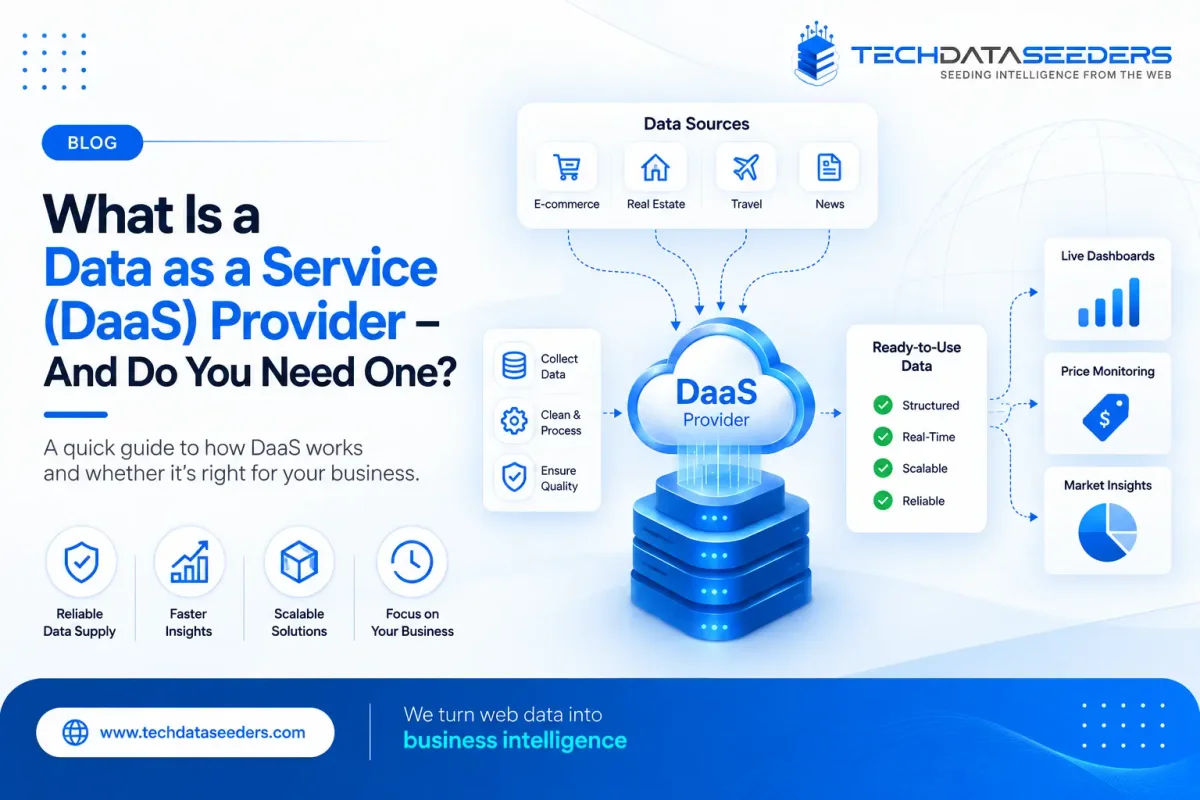
What Is Data as a Service Provider?
A Data as a Service Provider is a company that collects, processes, manages, and delivers data to businesses in a ready-to-use format.
Rather than requiring a business to build its own data collection systems, a DaaS provider manages much of the work behind the scenes.
The process can involve:
Data sources → Data collection → Cleaning → Validation → Structuring → Delivery
For example, an e-commerce company may want to monitor competitor prices across hundreds of websites. Instead of manually checking those websites or building an internal scraping system, the company can use a DaaS provider to collect the information regularly and deliver it through an API, database, file, or other data feed.
The important distinction is that DaaS is not simply about scraping a website once.
It is about creating a repeatable data supply system that businesses can depend on.
A good provider can handle the technical side of collection while your team focuses on analyzing and using the resulting data.
How Does Data as a Service Work?
The exact workflow depends on the type of data and the business requirements, but most DaaS solutions follow a similar process.
1. Identify Data Sources
The first step is identifying where the required information exists.
Sources could include:
- E-commerce websites
- Marketplaces
- Business directories
- Real estate portals
- Travel websites
- Financial websites
- News platforms
- Public databases
- Industry-specific websites
The provider determines which sources are relevant and what information needs to be collected.
2. Automate Data Collection
Once the sources and fields are defined, automated data collection systems are configured to gather the required information.
Depending on the website, this can involve web crawlers, APIs, browser automation, HTML parsing, JavaScript rendering, or other extraction methods.
Automation is particularly useful when data needs to be collected repeatedly.
Instead of having an employee manually copy information every day, the system can collect and process the data according to a predefined schedule.
3. Clean and Normalize the Data
Raw data isn't always ready for business use.
Different sources may use different naming conventions, formats, currencies, units, or structures.
For example, one website may list a price as "$1,500," while another uses "1500 USD."
Data cleaning and normalization can convert these differences into a consistent format.
This makes it easier to combine information from multiple sources and use it within analytics platforms, databases, or business applications.
4. Validate the Dataset
Data validation helps identify missing values, duplicate records, unexpected changes, and extraction errors.
A reliable DaaS workflow should have quality checks in place before information is delivered to the customer.
5. Deliver the Data
Finally, the processed information is delivered in a format that fits the business workflow.
This may include:
- APIs
- JSON
- CSV
- Excel
- Databases
- Cloud storage
- Custom data feeds
The result is a continuous or scheduled flow of usable data without requiring your internal team to manage every part of the collection process.
What Does a Data as a Service Provider Deliver?
A Data as a Service Provider can deliver much more than a spreadsheet containing scraped information.
Depending on the project, businesses may receive structured datasets, recurring data feeds, APIs, cleaned records, historical data, or continuously updated information.
For example, a retailer might receive:
Product → Brand → Price → Availability → Rating → Review Count → Product URL
The same type of structured approach can be applied to property listings, restaurant menus, job postings, financial information, travel prices, or competitor data.
Data Feeds
Data feeds are particularly useful when businesses need information to flow into their systems on a regular basis.
Instead of manually downloading a new dataset every week, updated information can be delivered automatically according to the agreed schedule.
This can support:
- Business intelligence dashboards
- Pricing systems
- Market research
- AI applications
- Internal databases
- Analytics platforms
- Monitoring tools
The delivery mechanism should therefore be considered when evaluating a DaaS provider—not treated as an afterthought.
Data as a Service vs. Traditional Web Scraping
DaaS scraper and traditional web scraping are related, but they aren't exactly the same thing.
Traditional web scraping often focuses on extracting information from specific websites. It can be a one-time project or a recurring process managed internally.
DaaS takes the concept further by treating data as an ongoing service.
| Traditional Web Scraping | Data as a Service |
|---|---|
| Often project-based | Usually ongoing |
| May provide raw data | Focuses on ready-to-use data |
| Maintenance may be internal | Provider can manage maintenance |
| Delivery may be manual | Automated delivery options |
| Scaling can require internal work | Designed for scalable data requirements |
| Quality control varies | Data validation can be built into the workflow |
A DaaS scraper is therefore only one component of the larger DaaS ecosystem.
The scraper collects the information, while the broader system handles processing, quality control, storage, monitoring, and delivery.
For businesses that need data continuously, that distinction can be important.
What Is a Web Data DaaS Provider?
A web data DaaS provider specializes in sourcing and delivering data collected from publicly available web sources.
Instead of giving a business a scraper and expecting its team to manage everything afterward, the provider can manage the complete data workflow.
Web data DaaS can be used for many different applications.
E-Commerce
Businesses can monitor:
- Product prices
- Availability
- Promotions
- Product descriptions
- Ratings
- Reviews
Real Estate
Property data can include:
- Listing prices
- Property types
- Locations
- Amenities
- Property status
- Listing details
Travel and Hospitality
Businesses can monitor hotel rates, availability, destinations, amenities, and other market information.
Market and Competitor Research
Companies can collect information from multiple competitors to understand pricing, product positioning, market movements, and changing customer offerings.
The value of a web data DaaS provider comes from turning information scattered across different websites into a consistent dataset that businesses can actually work with.
Benefits of Data as a Service for Businesses
There are several Benefits of Data as a Service, especially for organizations that rely heavily on external data.
1. Less Infrastructure to Manage
Building an internal data collection system requires developers, infrastructure, monitoring, proxies, storage, and ongoing maintenance.
DaaS can reduce much of that operational workload.
2. Faster Access to Data
Instead of spending months building an extraction pipeline, businesses can work with an existing data collection infrastructure and start receiving the required information sooner.
3. More Consistent Data
A managed data pipeline can include cleaning, normalization, validation, and deduplication processes.
This makes the final dataset more consistent and easier to use.
4. Easier Scalability
As your requirements grow, the data collection infrastructure can be scaled accordingly.
You may start with a few sources and eventually expand to hundreds or thousands of websites.
5. Reduced Maintenance Work
Websites change constantly. A scraper that works today may fail after a website redesign.
With a managed DaaS solution, scraper monitoring and maintenance can be handled as part of the service.
6. Better Support for AI and Analytics
AI models, analytics platforms, and business intelligence systems are only as useful as the data behind them.
Fresh and structured external data can support:
- Market intelligence
- Predictive analytics
- Machine learning
- Competitive intelligence
- Pricing optimization
- Recommendation systems
- Business dashboards
These are some of the biggest Benefits of Data as a Service for data-driven organizations.
When Do You Need a Data as a Service Provider?
Not every business needs DaaS.
If you need a small dataset once for a simple research project, building a long-term Data Analytics & Intelligence Services pipeline may not make much sense.
However, a Data as a Service Provider can be a strong fit if your business needs external data continuously.
You may want to consider DaaS if:
- You need data from multiple websites
- Data needs to be updated regularly
- Your data volume is growing
- Your team doesn't have dedicated scraping expertise
- Maintaining scrapers is taking too much time
- You need structured datasets rather than raw information
- You want data delivered automatically
- Your analytics or AI systems depend on external data
For example, if your team spends several hours every week collecting competitor pricing manually, that's a good sign that the process could benefit from automation.
The same applies when your developers spend more time fixing scrapers than actually working on your core product.
Managed Datasets vs. Building Your Own Data Pipeline
One of the biggest decisions businesses face is whether to build their own data pipeline or rely on managed datasets from a DaaS provider.
There is no universal answer.
Building In-House
An internal data pipeline gives you greater control over the entire process.
But you'll also need to handle:
- Scraper development
- Infrastructure
- Proxy management
- Data storage
- Monitoring
- Maintenance
- Quality control
- Scaling
This can make sense for companies that already have a strong data engineering team and specific long-term requirements.
Using Managed Datasets
With managed datasets, the provider takes responsibility for much of the collection and maintenance process.
This can save development time and reduce the operational burden on your team.
Managed datasets can be particularly useful when your priority is getting reliable data, rather than building the infrastructure used to collect it.
The right choice depends on your budget, technical resources, data requirements, and how strategically important the collection infrastructure itself is to your business.
How Much Does Data as a Service Cost?
There isn't a single fixed price for DaaS.
The cost depends on what you're collecting and how frequently you need it.
Common pricing factors include:
- Number of data sources
- Number of records
- Scraping frequency
- Website complexity
- Number of pages
- Data fields required
- Processing requirements
- Historical data requirements
- API or data-feed requirements
- Storage requirements
- Maintenance and monitoring
For example, collecting a few thousand product records once a month will have very different requirements from collecting millions of records from hundreds of websites every day.
When comparing providers, don't look only at the initial price.
Consider the total cost of getting reliable data.
A cheaper service may not include maintenance, quality control, infrastructure, or ongoing monitoring. Those costs may eventually fall back on your internal team.
What Should You Look for in a Data as a Service Provider?
Keeping in mind Data As A Service Market situation, choosing a DaaS partner deserves the same attention as choosing any other technology provider.
Before signing up, consider the following.
Data Quality
Ask how the provider validates, cleans, and updates the data.
Source Coverage
Make sure they can collect information from the websites and sources that actually matter to your business.
Scalability
Your data requirements may grow, so the infrastructure should be able to handle increasing volumes.
Update Frequency
Find out whether data can be updated daily, hourly, in real time, or according to your specific requirements.
Data Delivery
Check whether the provider supports APIs, databases, files, or other data feeds that fit your workflow.
Maintenance
Ask how website changes, failed extraction jobs, and scraper errors are detected and resolved.
Customization
A good provider should be able to adapt the dataset to your specific business requirements rather than offering only a fixed package.
Responsible Data Collection
Understand how the provider approaches publicly available data, website restrictions, privacy, and applicable regulations.
Ultimately, the best Data as a Service Provider isn't necessarily the one offering the most data. It's the one that can consistently deliver the right data in the right format at the right frequency.
Is Data as a Service Right for Your Business?
Still unsure whether DaaS makes sense?
Here's a simple way to look at it.
DaaS may be a good fit if you:
- Need recurring external data
- Work with multiple web sources
- Need large or growing datasets
- Want to automate data collection
- Don't want to maintain scraping infrastructure
- Need data for analytics or AI
- Want your developers focused on core products
DaaS may not be necessary if you:
- Need a small dataset only once
- Already have a capable internal data engineering team
- Collect information from a very small number of stable sources
- Don't require frequent updates
The decision ultimately comes down to whether managing data collection yourself creates more value than the time and resources it consumes.
If maintaining your own system has become a distraction, a Data as a Service Provider can take that responsibility off your team's plate.
Why Choose Techdataseeders for Data as a Service?
Techdataseeders helps businesses turn publicly available web information into structured, business-ready data.
Depending on the project requirements, data can be collected from multiple sources, processed, cleaned, and organized into datasets designed for specific business applications.
The approach can support use cases such as competitive intelligence, market research, e-commerce monitoring, real estate data, pricing intelligence, and other data-driven workflows.
Instead of treating data extraction as a standalone scraping task, the focus is on creating a reliable data pipeline—from collection and processing to delivery.
For businesses that need recurring datasets, customized extraction, or scalable web data collection, this approach can reduce the technical workload involved in maintaining the entire process internally.
FAQs
A Data as a Service Provider collects, processes, manages, and delivers data to businesses in a structured and usable format. Depending on the requirements, the provider may handle data collection, cleaning, validation, monitoring, and delivery so businesses don't have to build the entire data infrastructure themselves.
The main Benefits of Data as a Service include faster access to external data, reduced infrastructure requirements, scalable data collection, less maintenance, consistent datasets, and automated delivery. DaaS can also support analytics, AI, machine learning, competitive intelligence, and business intelligence applications.
A DaaS scraper is a web scraping component used as part of a broader Data as a Service workflow. It collects information from specified web sources, while the wider system can handle cleaning, validation, storage, monitoring, and delivery.
Data feeds are structured deliveries of information that allow businesses to receive updated data automatically. They can be delivered through APIs, files, databases, cloud storage, or other methods depending on how the data will be used.
Managed datasets are data collections maintained and updated by a provider rather than requiring the customer to manage the complete collection process. Depending on the service, this may include ongoing extraction, data cleaning, validation, monitoring, and scheduled updates.
Web scraping primarily refers to the process of extracting information from websites. DaaS is a broader service model that can include web scraping along with data processing, cleaning, validation, storage, monitoring, and delivery.
A business should consider a Data as a Service Provider when collecting and maintaining external data is taking significant time or development resources, or when the organization needs to scale data collection quickly.