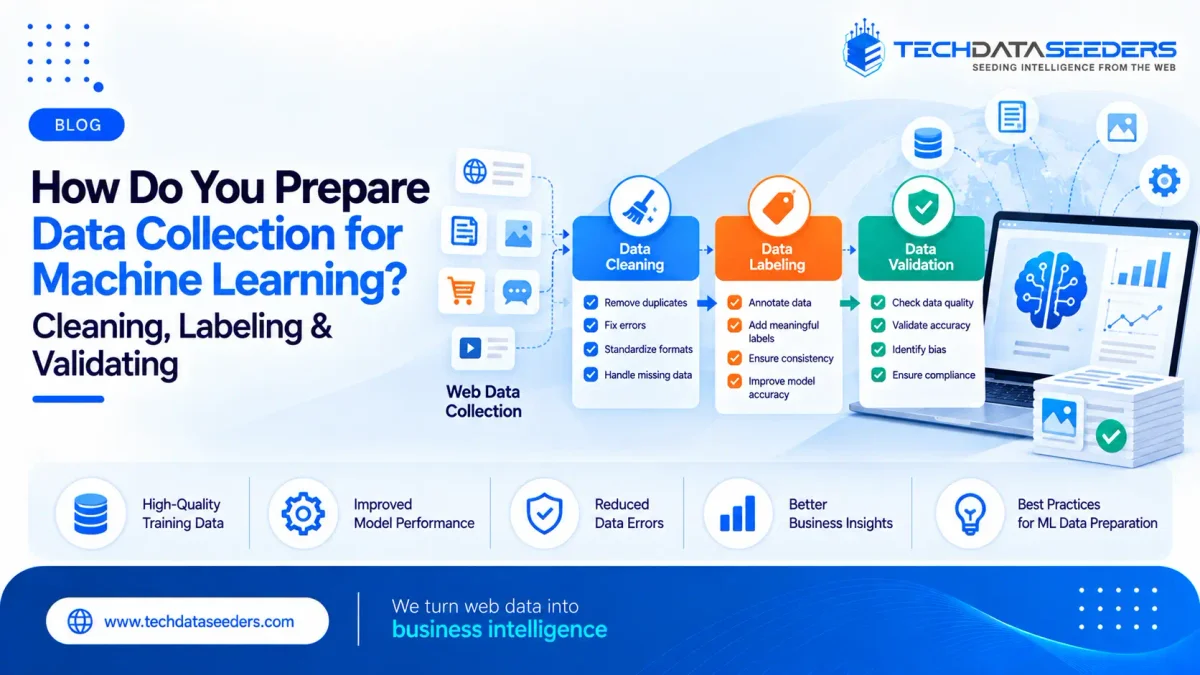
What Is Data Collection for Machine Learning?
Data Collection for Machine Learning involves sourcing relevant datasets and preparing them so they can be reliably used for model training, validation, and testing. Depending on the ML project, the process may involve collecting text, images, video, audio, product information, customer interactions, sensor readings, or other structured and unstructured data.
A typical workflow looks like this:
Data sources → ML data collection → Cleaning → Labeling → Validation → Dataset preparation → Model training
The collection stage should begin with the model's intended purpose rather than simply collecting whatever data is available.
What Types of Data Can Be Collected for Machine Learning?
The appropriate data depends on the machine learning task.
Examples include:
- Text documents
- Product information
- Images
- Videos
- Audio
- Customer reviews
- Web content
- Transaction records
- Sensor data
- Public datasets
- Domain-specific business data
For example, an ecommerce recommendation model may require product attributes, customer interactions, reviews, and purchasing patterns, while an image classification model may require thousands of labeled images.
How Do You Plan ML Data Collection Before Gathering Data?
ML data collection should begin by defining the machine learning objective, required data fields, target population, data sources, and quality requirements. Planning these elements before collection helps prevent businesses from creating large datasets that later turn out to be incomplete, irrelevant, or difficult to use.
Define the Machine Learning Objective
Start by answering:
- What should the model predict?
- What type of inputs will it receive?
- What output should it generate?
- How will model performance be evaluated?
The answers determine what data needs to be collected.
Identify the Required Data Attributes
Create a data specification before collection begins.
For example, an ecommerce recommendation project may require:
| Data attribute | Example |
|---|---|
| Product ID | P12345 |
| Category | Running Shoes |
| Product attributes | Size, brand, material |
| Customer interaction | Product view |
| Review | Customer feedback |
| Timestamp | 2026-10-07 |
This creates a clear target for the Data Collection for Machine Learning process.
Define Data Coverage
A useful dataset should represent the situations in which the model will actually operate.
Consider:
- Geographic coverage
- Product categories
- Languages
- Customer segments
- Time periods
- Different data sources
- Edge cases
This helps reduce gaps in the training data.
How Does Data Cleaning for Machine Learning Improve Dataset Quality?
Data cleaning for machine learning removes or corrects problems such as duplicate records, missing values, inconsistent formats, invalid entries, and irrelevant data before the dataset is used for training. Cleaning is important because models learn from the patterns present in their input data, including unwanted patterns caused by poor-quality records.
Remove Duplicate Records
Duplicate data can distort the distribution of the dataset.
For example, if the same product appears 20 times because of repeated collection, the model may treat that product as more representative than it actually is.
Deduplication can be performed using:
- Unique IDs
- URLs
- Hashes
- Product attributes
- Record-level similarity
Handle Missing Values
Missing information should be identified before training.
Possible approaches include:
- Removing unsuitable records
- Filling values where appropriate
- Marking missing values explicitly
- Collecting additional information
The correct approach depends on why the information is missing and how important the field is to the model.
Standardize Data Formats
Machine learning datasets may combine information from different sources.
For example:
- USD vs EUR
- Kilograms vs pounds
- Different date formats
- Uppercase vs lowercase labels
- Different category names
Standardization creates more consistent training data.
Remove Irrelevant or Low-Value Data
Not every collected field contributes to the machine learning objective.
Removing irrelevant attributes can simplify the dataset and reduce unnecessary processing.
What Is Machine Learning Data Labeling and Why Is It Important?
Machine learning data labeling assigns meaningful labels or annotations to raw data so a supervised learning model can learn the relationship between inputs and expected outputs. The labeling process varies according to the type of ML problem and can involve humans, automated systems, or a combination of both.
Common Types of Machine Learning Data Labeling
Image Labeling
Images can be labeled for:
- Object classification
- Object detection
- Image segmentation
- Facial or visual attributes, where appropriate
Text Labeling
Text can be classified by:
- Sentiment
- Topic
- Intent
- Entity
- Category
For example, customer reviews could be labeled as positive, neutral, or negative.
Audio Labeling
Audio datasets can include labels such as:
- Speech segments
- Language
- Speaker characteristics
- Sounds
- Transcriptions
Why Label Consistency Matters?
Suppose one annotator labels a review as positive, while another labels an almost identical review as neutral.
Inconsistent labeling can introduce noise into the training dataset.
A labeling project should therefore establish:
- Clear annotation guidelines
- Label definitions
- Examples
- Edge-case rules
- Review procedures
What Is Data Quality Validation in Machine Learning?
Data quality validation checks whether collected and prepared data is accurate, complete, consistent, relevant, and suitable for the intended machine learning task. Validation should happen throughout the pipeline rather than only after the entire dataset has been collected.
What Does Data Quality Validation Check?
A validation framework may check:
- Missing values
- Duplicate records
- Invalid formats
- Incorrect labels
- Outliers
- Unexpected values
- Schema changes
- Data distribution
- Source consistency
For example, if a product price field should contain a positive numerical value, validation rules can flag records containing text or impossible values.
Validate Data Against Expected Schemas
A schema can define:
- Required fields
- Data types
- Allowed values
- Field formats
- Relationships between fields
This makes it easier to identify unexpected changes during collection.
What Does a Complete ML Data Preparation Pipeline Look Like?
A complete ML data preparation pipeline moves data through collection, cleaning, labeling, validation, and final dataset preparation before the information reaches the model training stage. Each stage should have defined quality checks so that problems can be identified before they propagate through the workflow.
A practical pipeline can look like this:
1. Data Collection
Gather relevant information from approved sources.
2. Data Cleaning
Remove duplicates, correct formatting issues, and address missing or invalid values.
3. Data Labeling
Add the labels required for supervised learning or other annotation tasks.
4. Data Quality Validation
Check completeness, consistency, validity, accuracy, and other quality requirements.
5. Dataset Splitting
Prepare appropriate training, validation, and test datasets.
6. Final Quality Review
Confirm that the dataset meets the project's requirements before training.
How Techdataseeders Supports Data Collection for Machine Learning?
Techdataseeders can support Data Collection for Machine Learning through structured web data collection, extraction, cleaning, validation, and delivery.
Depending on the project, the workflow can support datasets containing:
- Product information
- Text
- Reviews
- Pricing data
- Images
- Listings
- Category information
- Other relevant web data
The collected information can be processed into structured datasets that are easier to integrate into machine learning workflows.
For larger projects, the process can be designed around specific collection frequencies, source requirements, data fields, validation rules, and delivery formats.
Conclusion
Data Collection for Machine Learning is much more than gathering a large amount of raw information. A reliable ML dataset needs relevant sources, consistent structure, appropriate labeling, strong data cleaning, and systematic validation.
The process can be summarized as:
Collect → Clean → Label → Validate → Prepare → Train
When each stage is treated as part of the overall data pipeline, businesses can create datasets that are more consistent, traceable, and suitable for machine learning applications.
FAQs for Data Collection for Machine Learning
The required volume depends on the model, task, data complexity, and desired performance. A smaller, well-prepared dataset can be more useful than a much larger dataset containing duplicates, inaccurate labels, or irrelevant records.
A dataset is closer to training readiness when required fields are complete, duplicates are controlled, labels follow defined rules, formats are consistent, and data quality validation shows that the dataset meets the project's quality thresholds.
Yes. Automated or AI-assisted labeling can accelerate machine learning data labeling, but human review may still be necessary for ambiguous examples, quality control, and high-impact use cases.
Excessive duplicates can distort the dataset and cause certain examples or patterns to be overrepresented. Data cleaning for machine learning should therefore include appropriate deduplication before the dataset is used for training.
Businesses can establish recurring ML data collection workflows that collect new information, apply cleaning and validation rules, and update the dataset according to the requirements of the machine learning application.
Yes. Web data can form part of an ML data collection workflow when the information is relevant and its collection and use comply with applicable legal, privacy, copyright, contractual, and platform requirements.
Labeling does not guarantee that a dataset is correct. Data quality validation can identify inconsistent labels, missing values, duplicates, invalid records, and other problems before they affect model training.