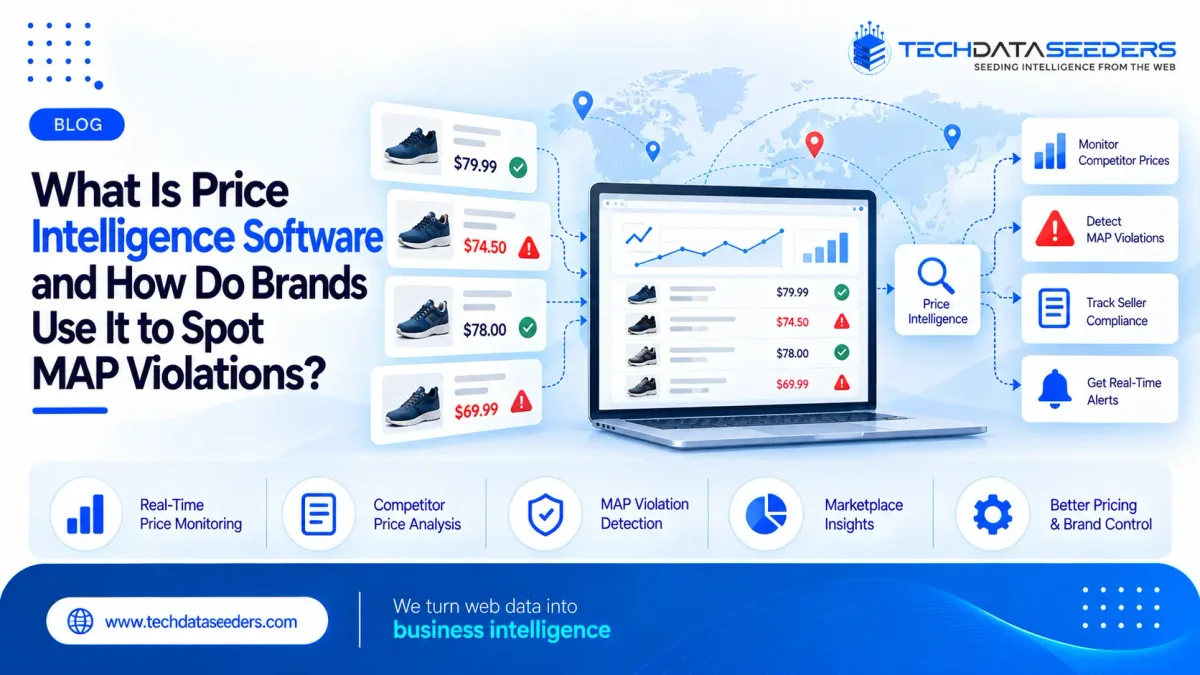
What Is Price Intelligence Software and How Does It Work?
Price Intelligence Software automatically collects and analyzes pricing information from relevant online channels so brands can understand market prices, competitor behavior, and potential pricing violations. Instead of reviewing retailer websites manually, brands can use structured pricing data to compare advertised prices against defined thresholds and monitor changes over time.
A typical system can bring together:
- Product prices
- Retailer or seller information
- Product URLs
- Discounts and promotions
- Product availability
- Marketplace listings
- Collection timestamps
- Historical price changes
The software can then normalize this information and make it easier to identify pricing patterns.
What Data Does Price Intelligence Software Track?
The exact data depends on the brand's requirements, but common fields include:
| Data | Purpose |
|---|---|
| Product/SKU | Identify the product |
| Advertised price | Compare against MAP |
| Retailer | Identify the seller |
| Product URL | Verify the listing |
| Discount | Understand promotional pricing |
| Availability | Add market context |
| Timestamp | Establish when the price was observed |
| Historical price | Track repeated changes |
This turns raw competitive price intelligence into usable data.
How Does MAP Violation Monitoring Work?
MAP violation monitoring compares advertised product prices against a brand's defined MAP thresholds and flags listings that appear to fall below those thresholds. A monitoring system typically collects retailer prices, matches products to the correct SKUs Pricing, applies the relevant MAP rules, and creates alerts or reports for potential violations.
The basic workflow looks like this:
Online listings → Product matching → Price collection → MAP comparison → Violation detection → Alert/report
Establish the Correct MAP Threshold
The first step is knowing the applicable MAP price for each product.
A brand may have different MAP prices for different:
- SKUs
- Product versions
- Markets
- Retail competitive intelligence channels
- Time periods
The monitoring system needs the correct threshold before it can identify a potential violation.
Match Retailer Listings to the Correct Products
Product matching is critical for the case of web scraping.
A retailer may use a different product title, SKU format, or product description than the manufacturer.
For example:
Brand SKU: ABC-500-BLK
Retailer SKU: 500-BLK
Marketplace title: Brand X Model 500 Black
The system must establish that these listings represent the same product before comparing the advertised price with the MAP threshold.
Compare Advertised Prices Against MAP
Once the product is correctly identified, the observed advertised price can be compared against the relevant MAP value.
For example:
| Product | MAP | Advertised Price | Status |
|---|---|---|---|
| Product A | $199 | $199 | Within MAP |
| Product B | $249 | $229 | Potential violation |
| Product C | $299 | $299 | Within MAP |
This provides a straightforward starting point for MAP violation detection.
How Does Competitive Price Intelligence Help Brands Detect MAP Violations?
Competitive price intelligence provides the broader market context needed to understand MAP compliance issues alongside competitor pricing, promotions, and retailer behavior. Instead of looking at one isolated price, brands can analyze how products are priced across multiple sellers and identify unusual patterns.
Compare Prices Across Retailers
A brand can create a market-wide view of its products.
For example:
- Retailer A: $499
- Retailer B: $499
- Retailer C: $479
- Retailer D: $499
If the MAP threshold is $499, Retailer C becomes a candidate for further investigation.
Identify Repeated Pricing Patterns
One below-MAP price may be an isolated event.
Repeated observations can reveal whether a seller:
- Frequently advertises below MAP
- Changes prices during weekends
- Discounts during promotions
- Repeatedly returns below the threshold
Historical competitive price intelligence makes these patterns easier to identify.
Understand the Wider Market
MAP monitoring should not exist in isolation.
Brands may also want to understand:
- Average market price
- Competitor pricing
- Discount frequency
- Product availability
- Promotional activity
- Price gaps between sellers
This broader context can help distinguish an isolated pricing event from a wider market movement.
How Does MAP Violation Detection Work at Scale?
MAP violation detection becomes more valuable at scale because brands may need to monitor hundreds or thousands of product listings across many sellers. Automation can continuously compare collected prices against the relevant MAP thresholds and surface exceptions for human review.
A scalable process can look like:
1. Collect retailer pricing data.
2. Identify the relevant product or SKU.
3. Normalize price information.
4. Apply the correct MAP threshold.
5. Flag potential violations.
6. Store the observation with a timestamp.
7. Generate alerts or reports.
8. Review and investigate the flagged listing.
Why Product Matching Matters
Incorrect matching can create false violations.
For example, comparing:
- A 64GB product against a 128GB product
- A single-unit product against a bundle
- A current model against an older model
could make a perfectly valid price appear non-compliant.
Reliable MAP violation detection therefore depends on accurate product identification.
Why Historical Data Matters
Historical data provides evidence of what was observed at a particular point in time.
A useful record can include:
- Product
- Retailer
- Advertised price
- MAP value
- Product URL
- Date and time
- Violation status
This makes it easier for teams to investigate pricing behavior rather than relying on screenshots or manual notes alone.
How Can Brands Use Price Intelligence Software for MAP Compliance?
Brands can use Price Intelligence Software to combine automated MAP monitoring with broader competitive analysis, allowing them to see potential violations while also understanding the market conditions around those prices. This creates a more complete pricing intelligence workflow than checking MAP thresholds alone.
Step 1: Build a Product-Level MAP Dataset
Create a structured list containing:
- SKU
- Product name
- MAP price
- Product category
- Relevant retailers
- Applicable market
Step 2: Identify the Retailers and Marketplaces to Monitor
Prioritize the channels that matter most to your distribution network.
You might start with:
- Major retail partners
- Key marketplaces
- High-volume sellers
- Historically problematic channels
Step 3: Automate Price Collection
Instead of manually checking every listing, establish scheduled collection.
The frequency should depend on how quickly prices change and how important rapid detection is to the brand.
Step 4: Match Products and Apply MAP Rules
Collected listings need to be mapped to the correct product and compared with the applicable MAP value.
Step 5: Review Potential Violations
Not every automated flag should immediately be treated as a confirmed violation.
Teams should review the listing, product, price, policy, and relevant circumstances.
Step 6: Analyze Recurring Patterns
Over time, brands can identify retailers or products associated with repeated potential violations.
This is where competitive price intelligence becomes particularly useful.
What Is the Difference Between Price Intelligence and MAP Compliance Monitoring?
Price intelligence focuses broadly on understanding market pricing, while MAP compliance monitoring focuses specifically on identifying advertised prices that may fall below a brand's defined MAP requirements. The two functions overlap, but they serve different business purposes.
| Price Intelligence | MAP Compliance Monitoring |
|---|---|
| Tracks market prices | Tracks prices against MAP |
| Analyzes competitors | Identifies potential violations |
| Supports pricing strategy | Supports compliance workflows |
| Measures price positioning | Measures advertised-price adherence |
| Provides market context | Provides violation alerts |
| Analyzes trends | Tracks retailer compliance patterns |
A strong Price Intelligence Software platform can support both workflows.
How Techdataseeders Can Support Price Intelligence and MAP Monitoring?
Techdataseeders can support Price Intelligence Software workflows through structured web data collection, competitor price monitoring, product data extraction, historical pricing datasets, and API-based data delivery.
For brands monitoring MAP, collected data can include:
- Product information
- Advertised prices
- Retailer details
- Product URLs
- Discounts
- Availability
- Timestamps
This data can then be cleaned, normalized, validated, and delivered into analytics or internal compliance workflows.
The result is a structured foundation for competitive price intelligence, MAP violation monitoring, and broader pricing analysis.
Conclusion
Price Intelligence Software gives brands a scalable way to monitor market pricing while supporting more focused MAP compliance workflows. By collecting retailer prices, matching products accurately, comparing advertised prices against MAP thresholds, and maintaining historical records, brands can identify potential violations without relying entirely on manual checks.
However, effective MAP compliance for brands is not simply about finding the lowest price. The quality of the underlying data, accuracy of product matching, relevance of MAP rules, and human review process all matter.
When these components work together, MAP compliance software can become part of a broader competitive intelligence system that helps brands understand both where pricing violations may occur and what is happening across the wider market.
FAQs
Price Intelligence Software collects and analyzes market pricing data from retailers, marketplaces, and other sources to help brands understand competitor prices, promotions, price changes, and market positioning.
MAP violation monitoring compares observed advertised prices with the applicable MAP threshold and flags prices that appear to fall below the brand's defined minimum advertised price.
MAP compliance software helps brands automate price collection, product matching, MAP comparisons, potential violation detection, alerts, historical tracking, and reporting.
MAP violation detection identifies listings where the observed advertised price appears to be below the relevant MAP threshold after the product and pricing data have been correctly matched.
Competitive price intelligence helps brands understand competitor pricing, promotions, price changes, retailer behavior, and market positioning while providing context for MAP monitoring.
Not necessarily. A below-MAP price should generally be treated as a **potential violation** that requires review against the brand's specific MAP policy, product information, retailer relationship, and applicable terms.
Historical data helps brands identify recurring pricing patterns, track potential violations over time, compare retailer behavior, and maintain a record of when specific advertised prices were observed.