What Is Grocery Pricing Intelligence?
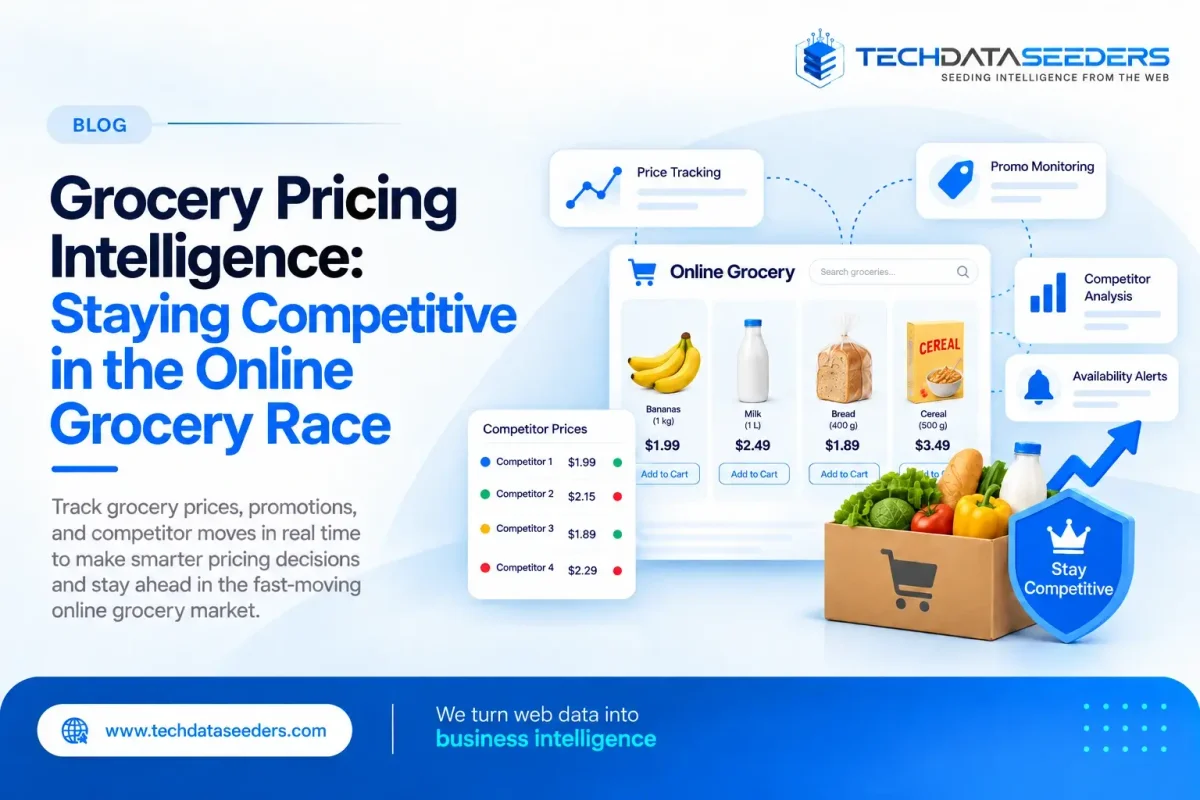
Grocery Pricing Intelligence is the process of collecting, analyzing, and interpreting pricing and competitive data from grocery retailers, marketplaces, and online grocery platforms.
The goal isn't simply to create a spreadsheet of product prices.
A useful grocery pricing intelligence system can help answer questions such as:
- Which competitors have the lowest prices?
- Which products experience frequent price changes?
- Where are competitors offering deeper discounts?
- Which products are consistently priced above the market?
- How do prices differ between grocery platforms?
- Which products are frequently out of stock?
- How does promotional activity change over time?
- Which categories are becoming more competitive?
For example, a grocery retailer may discover that its competitive price tracking across most of its catalog but consistently higher on 50 high-visibility products.
That insight can help the pricing team prioritize those products instead of changing prices across the entire catalog.
Why Grocery Pricing Is Different From Other Retail Categories
Grocery & Quick Commerce Data Scraping Services pricing has several characteristics that make competitive monitoring particularly important.
High Purchase Frequency
Customers purchase groceries regularly, so they can become highly familiar with the prices of everyday products.
Large Product Catalogs
A grocery platform may have thousands or tens of thousands of SKUs across food, beverages, personal care, household products, and other categories.
Frequent Promotions
Discounts, coupons, bundles, loyalty offers, and seasonal campaigns can change the effective selling price.
Perishable Products
Fresh products may have different pricing dynamics because of shelf life, inventory, demand, and supply.
Local Pricing
Prices and availability can vary by location, store, fulfillment center, or delivery area.
Strong Price Competition
Online grocery platforms make it easier for consumers to compare similar products across retailers.
Because of these factors, Grocery Pricing Intelligence needs to consider more than just the displayed product price.
Extract Pricing Data from Grocery Platforms
Businesses that Extract Pricing Data from Grocery Platforms can build a structured view of competitor pricing across products and categories.
Depending on the source and permitted access method, relevant fields may include:
- Product name
- Product ID
- Brand
- Category
- Pack size
- Current price
- Original price
- Sale price
- Discount
- Unit price
- Promotion
- Availability
- Seller or retailer
- Location
- Timestamp
The unit price is particularly important for grocery products.
Consider two products:
| Product | Pack Size | Price | Price per 100g |
|---|---|---|---|
| Brand A | 500g | $4.50 | $0.90 |
| Brand B | 750g | $5.85 | $0.78 |
Looking only at the displayed price makes Brand B appear more expensive.
Unit-level normalization tells a different story.
When businesses Extract Pricing Data from Grocery Platforms, standardizing pack sizes and units can therefore make cross-product comparisons much more meaningful.
Grocery Price Data Scraping: What Should Be Collected?
Grocery Price Data Scraping involves collecting relevant product and pricing information from online grocery sources and organizing it into a usable dataset.
Using Custom Data Extraction Services, a strong grocery pricing dataset can contain several layers of information.
Product-Level Data
- Product name
- Brand
- Category
- Subcategory
- Size
- Weight
- Quantity
- Product attributes
Price-Level Data
- Regular price
- Promotional price
- Discount
- Unit price
- Coupon
- Multi-buy price
- Price per quantity
Availability Data
- In stock
- Out of stock
- Limited availability
- Delivery availability
Competitive Data
- Competitor
- Seller
- Location
- Product position
- Timestamp
Historical Data
- Previous price
- Price-change date
- Promotion history
- Historical availability
This historical layer is important because grocery pricing isn't static.
A retailer may reduce the price of a product for two days and return it to its regular price afterward.
Without historical data, that temporary promotion could be mistaken for the competitor's normal price.
How Grocery Price Data Scraping Works
A typical Grocery Price Data Scraping workflow can look like this:
- Grocery Platforms
- Product Discovery
- Price & Promotion Extraction
- Data Cleaning
- Product Matching
- Unit & Currency Normalization
- Historical Storage
- Competitive Analysis
Each step solves a different problem.
Grocery Store Data Extraction for Competitive Monitoring
Grocery Store Data Extraction can extend beyond price. Retailers may want to understand the entire competitive assortment.
For example, a business could monitor:
- Product catalogs
- Product prices
- Promotions
- Brand availability
- Pack sizes
- Product variations
- Ratings and reviews
- Stock availability
- Category structure
- New product additions
This broader Grocery Store Data Extraction approach helps retailers understand not only how competitors price products but also what they sell and how their assortment changes.
Suppose a competitor begins adding more organic products to a category.
A pricing-only dataset might miss this development.
A broader grocery store dataset could reveal the assortment shift early, giving the retailer an opportunity to investigate the category before the change becomes more significant.
Product Matching Is Critical in Grocery Pricing
One of the hardest parts of grocery competitive intelligence is matching equivalent products.
Consider:
Retailer A: "Coca-Cola Original Taste 1.5L"
Retailer B: "Coke Soft Drink 1.5 L Bottle"
Retailer C: "Coca Cola 1500ml"
These may represent the same product even though the names are different.
A matching system can use:
- Brand
- Product name
- Size
- Weight
- Pack quantity
- Product attributes
- GTIN/EAN/UPC where available
- Product identifiers
This is especially important when Grocery Price Data Scraping is used for large catalogs.
Incorrect product matching can create false price gaps and lead to poor pricing decisions.
Real-Time Grocery Price Intelligence
Traditional competitive reports may tell a retailer what happened yesterday.
Real-Time Grocery Price Intelligence aims to provide a much faster view of market changes.
This can be particularly useful when prices or promotions change frequently.
For example:
8:00 AM
Competitor A price = $5.99
10:00 AM
Competitor A price = $4.99
10:15 AM
Competitor B launches a $1 discount
11:00 AM
Your price = $5.99
A real-time or near-real-time monitoring system can flag these changes quickly.
The retailer can then determine whether action is necessary.
Importantly, "real-time" should be defined according to the business requirement. Some grocery businesses may need hourly updates, while others may find daily monitoring sufficient.
The right refresh frequency depends on:
- Product category
- Competitive intensity
- Price volatility
- Business value
- Promotional frequency
- Inventory conditions
What Real-Time Grocery Price Intelligence Can Detect?
A Real-Time Grocery Price Intelligence system can detect events such as:
Price Drops: A competitor reduces the price of a monitored product.
Price Increases: A competitor raises its price, potentially changing your relative position.
Promotion Launches: A new discount or promotional price appears.
Promotion Expiration: A temporary offer disappears.
Stock Changes: A product moves from available to unavailable.
New Products: A competitor introduces a new product or variation.
Competitive Price Gaps: Your price moves outside a predefined competitive range.
These events can be delivered through dashboards, reports, alerts, APIs, or data feeds.
How Grocery Pricing Intelligence Supports Dynamic Pricing?
Grocery Pricing Intelligence can provide one of the external data inputs used in dynamic pricing systems.
But competitive pricing should not operate in isolation.
A grocery retailer might combine the following events to determine an appropriate pricing action:
- Competitor Prices
- Customer Demand
- Inventory
- Margin
- Promotions
- Seasonality
- Historical Sales
For example, if a competitor drops the price of a popular cereal by 10%, the retailer doesn't necessarily need to match it immediately.
The retailer may first consider:
- Current stock
- Product demand
- Profit margin
- Competitor promotion duration
- Historical price
- Customer price sensitivity
This helps prevent unnecessary price cuts.
Monitoring Promotions and Discounts
Promotional pricing can make grocery comparisons difficult.
A product might have:
- 10% off
- Buy 2, Get 1
- Buy 1, Get 1
- Member-only pricing
- Digital coupons
- Multi-pack discounts
- Limited-time offers
Simply comparing the standard listed price may therefore provide an incomplete picture.
A useful Grocery Pricing Intelligence workflow should capture promotional context where it is publicly available and relevant to the comparison.
For example:
| Product | Regular Price | Promotion | Effective Price |
|---|---|---|---|
| Cereal A | $6.00 | 20% off | $4.80 |
| Cereal B | $5.50 | None | $5.50 |
| Cereal C | $6.20 | Buy 2 for $10 | $5.00 each |
This makes competitive pricing analysis more realistic.
Grocery Pricing Intelligence by Category
Not every grocery category needs the same pricing strategy.
Retailers can segment competitive intelligence by category via Techdataseeders Enterprise Web Scraping Services, such as:
Fresh Produce: Monitor seasonal price changes, pack sizes, and local availability.
Dairy: Track frequently purchased products and competitive price gaps.
Beverages: Monitor brand-level pricing, promotions, and multipack offers.
Packaged Foods: Compare brands, pack sizes, discounts, and assortment.
Personal Care: Track product-level pricing and promotional activity.
Household Products: Monitor competitive pricing across frequently purchased essentials.
This category-level approach helps pricing teams understand where competition is strongest.
Grocery Pricing Dashboards: From Raw Data to Decisions
Raw pricing data becomes much more useful when presented through a focused dashboard.
A grocery pricing dashboard could include:
| Metric | Purpose |
|---|---|
| Current competitor price | Market comparison |
| Your current price | Internal benchmark |
| Price gap | Competitive difference |
| Unit price | Normalized comparison |
| Discount | Promotion analysis |
| Competitor count | Competitive pressure |
| Stock status | Availability context |
| Price history | Trend analysis |
| Category index | Category-level position |
| Last updated | Data freshness |
Common Challenges With Grocery Data Extraction
Large-scale grocery Data Analytics & Intelligence Services projects come with several practical challenges such as.
Location-Based Pricing: Prices can differ between cities, stores, delivery zones, or fulfillment locations.
Pack Size Differences: Products may have different weights, quantities, or multipacks.
Promotions: Temporary offers can make direct price comparisons misleading.
Product Variations: The same product may appear under different names or configurations.
Frequent Changes: Pricing and availability can change throughout the day.
Large Catalogs: Monitoring thousands of grocery products across several platforms creates substantial data volume.
Data Quality: Missing prices, duplicate listings, incorrect product matches, and stale records can affect analysis.
This is why Grocery Store Data Extraction should include validation and normalization rather than simply collecting raw marketplace information.
How Businesses Can Use Grocery Pricing Intelligence?
Businesses use grocery pricing intelligence to track competitor rates, optimize profit margins, and adjust prices dynamically based on real-time market data.
Once grocery data is structured, it can be used by multiple teams.
Pricing Teams: Monitor competitor price movements and identify products requiring review.
Category Managers: Understand category-level competitive positioning.
Merchandising Teams: Compare product assortment and identify catalog gaps.
E-commerce Teams: Monitor online product availability and promotions.
Business Analysts: Analyze historical pricing and market trends.
Management: Track overall competitive positioning across grocery categories.
The same underlying dataset can therefore support multiple business functions.
How Techdataseeders Supports Grocery Data Intelligence
Techdataseeders provides web data extraction and intelligence solutions that can be adapted to retail and e-commerce use cases.
For grocery businesses, a data workflow can be structured around:
- Grocery product data
- Competitor pricing
- Promotional pricing
- Product catalogs
- Store and marketplace data
- Availability monitoring
- Historical price tracking
- Product matching
- Structured data delivery
- Competitive analytics
How to Build a Grocery Pricing Intelligence Strategy?
A practical approach to Grocery Pricing Intelligence Strategy is:
Identify Key Competitors: Choose the grocery platforms or retailers that have the biggest impact on your market.
Select Important Products: Start with high-volume, high-visibility, or highly price-sensitive SKUs.
Define Required Data: Determine whether you need price, unit price, promotions, availability, seller information, or additional fields.
Set Monitoring Frequency: Choose hourly, daily, weekly, or another frequency based on pricing volatility.
Normalize Products: Match equivalent products and standardize units.
Store Historical Data: Maintain previous observations to identify pricing trends.
Build Competitive Metrics: Create price gaps, indexes, benchmarks, and category-level comparisons.
Create Alerts: Flag meaningful price and promotion changes.
Connect to Business Systems: Deliver the data through dashboards, APIs, feeds, or internal databases.
This approach allows businesses to gradually expand their Grocery Pricing Intelligence program as its value becomes clear.
Final Thoughts
Online grocery competition moves quickly.
A price that was competitive yesterday may not be competitive today. A temporary promotion can change the market position of a product, while an out-of-stock competitor can create a completely different pricing opportunity.
That is why modern grocery businesses need more than occasional competitor checks.
Grocery Pricing Intelligence creates a structured way to understand pricing, promotions, assortment, and availability across the market.
By combining Grocery Price Data Scraping, Grocery Store Data Extraction, and Real-Time Grocery Price Intelligence, retailers can move from reactive price checking to continuous competitive monitoring.
The goal isn't to match every competitor.
It's to know where the market is moving, which changes matter, and when your business should respond.
FAQs for Grocery Pricing Intelligence
Grocery Pricing Intelligence is the process of collecting and analyzing grocery pricing, promotion, availability, and competitive data to support better pricing decisions.
It helps retailers compare prices, identify pricing gaps, monitor promotions, and understand competitor pricing behavior.
Grocery Price Data Scraping involves collecting structured product and pricing information from online grocery platforms and retailer websites.
It can include product information, prices, promotions, availability, categories, brands, pack sizes, and other publicly available store data.
It provides frequent or near-real-time visibility into competitor price and promotional changes so retailers can respond faster.
The ideal frequency depends on product category, competition, price volatility, and business requirements. Some products may need hourly monitoring, while others can be checked daily.
Yes. Competitor prices can be combined with demand, inventory, margins, promotions, and historical sales to support data-driven pricing decisions.