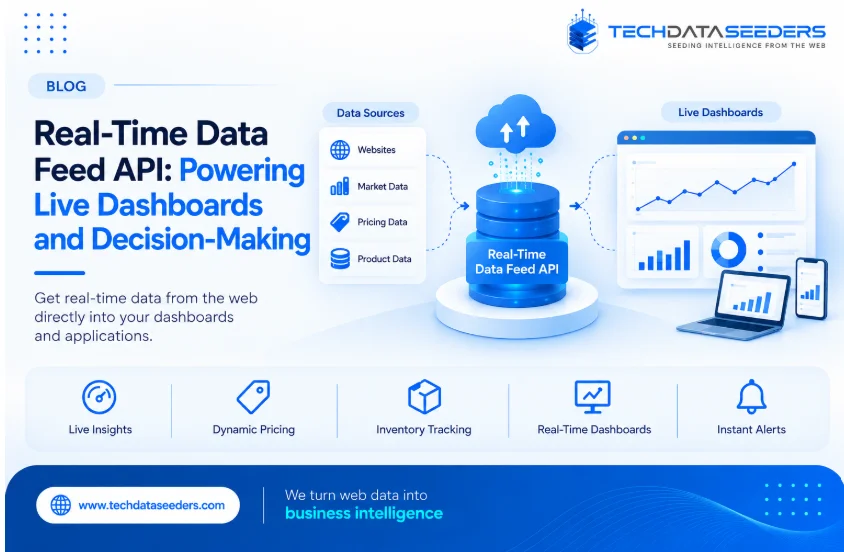
What Is a Real-Time Data Feed API?
A Real-Time Data Feed API is an API that delivers continuously updated or frequently refreshed data to applications and systems as new information becomes available.
A traditional data workflow might look like:
Website / Data Source → Scheduled Scraping → CSV → Database → Dashboard
A real-time workflow can instead look like:
Data Source → Real-Time Data Feed API → Processing → Database / Dashboard / Application
The API acts as a connection between the incoming data and the systems that need to use it.
Depending on the use case, a real-time feed may deliver:
- Product prices
- Stock or market information
- Inventory changes
- Travel fares
- Property listings
- News and events
- Competitor data
- Availability information
- Customer or application activity
The important factor is data freshness. A real-time Web Scraping APIs is designed to reduce the delay between a change occurring at the source and that change becoming available to the application.
How Does a Live Data Feed API Work?
A Live Data Feed API continuously or periodically retrieves information from defined sources and makes the updated data available through an API endpoint.
A simplified workflow looks like this:
Data Sources
↓
Collection & Extraction
↓
Data Validation
↓
Live Data Feed API
↓
Application / Dashboard / Database
When a source changes, the collection layer detects or retrieves the new information. The data can then be cleaned, standardized, validated, and delivered through the API.
The exact meaning of "real-time" depends on the project.
Some businesses may need updates every few seconds. Others may only need information refreshed every few minutes.
For example, a competitor price monitoring system may not need second-by-second updates, while a financial application may require much lower latency.
That's why the required refresh frequency and latency should be defined before building the feed.
Why Do Businesses Need Real-Time Data?
The value of real-time data isn't simply that it is newer.
It's that businesses can act on changes while they still matter.
Imagine an e-commerce company monitoring competitor prices.
If a competitor reduces the price of a high-volume product at 9 AM but your system doesn't receive the information until the next morning, the business may spend an entire day making decisions based on outdated information.
With a real-time or near-real-time feed, the updated price can flow into the company's monitoring system much sooner.
The same principle applies to:
- Market monitoring
- Dynamic pricing
- Inventory tracking
- Fraud detection
- Demand monitoring
- Travel pricing
- Financial analytics
- Operational dashboards
Real-time data doesn't automatically make a business smarter. But it gives decision-makers a much better chance of responding while the information is still useful.
API for Live Dashboards: Turning Fresh Data Into Action
A dashboard is only as useful as the data behind it.
An API for Live Dashboards allows dashboards to receive updated information without relying entirely on manual exports or static reports.
For example, a competitive intelligence dashboard could display:
| Metric | Current Value |
|---|---|
| Competitor Products Tracked | 25,000+ |
| Price Changes Today | 1,284 |
| Products Out of Stock | 346 |
| Average Price Change | 3.8% |
| Last Data Update | 2 mins ago |
Instead of generating a report at the end of the day, the dashboard can continuously reflect the latest available information.
This is particularly useful for teams such as:
- Pricing teams
- Sales teams
- Operations teams
- Market researchers
- Financial analysts
- Supply chain managers
- E-commerce teams
The API becomes the bridge between raw incoming data and the visual layer used by decision-makers.
Data Feed API for Dashboards: What Data Can You Display?
A Data Feed API for Dashboards can support a wide range of business information.
For example, an e-commerce dashboard might display:
Competitor → Product → Current Price → Previous Price → Discount → Availability → Timestamp
A real estate dashboard could track:
Property → Location → Price → Property Type → Availability → Listing Status → Last Updated
A market intelligence dashboard could show:
Company → Product → Market Position → Price → Reviews → Availability → Change Over Time
The key advantage is that the dashboard doesn't have to directly understand how the original website or source works.
The API provides a consistent data layer that the dashboard can consume.
Real-Time Market Data API for Faster Decisions
Financial and market intelligence applications are some of the clearest examples of where timing matters.
A Real-Time Market Data API can deliver frequently updated information to applications that monitor market conditions, prices, trends, or other financial indicators.
Depending on the specific application and licensed data sources, this could include:
- Market prices
- Trading information
- Economic indicators
- Company information
- Market movements
- News signals
- Historical comparisons
For financial use cases, latency and data accuracy become especially important.
A feed that updates every few minutes may be perfectly suitable for market research but inadequate for an application that requires second-level updates.
Therefore, businesses should define their latency requirements before selecting or developing a real-time market data solution.
Building a Streaming Data Pipeline
A Streaming Data Pipeline is designed to move data continuously rather than waiting for large batches to accumulate.
A traditional batch pipeline might process information:
Every hour → Every day → Every week
A streaming pipeline instead processes data as it arrives or at very short intervals.
A typical architecture could look like:
Web Sources / APIs
↓
Data Collection
↓
Streaming Layer
↓
Validation & Transformation
↓
Data Store
↓
Live Dashboard / Application
This architecture can be useful when the business needs to respond quickly to changing information.
However, streaming doesn't mean every component has to operate at exactly the same speed.
For example, the collection layer may retrieve data every minute while the dashboard updates every few seconds from the processed data store.
The modern data streaming architecture should therefore be designed around the actual business requirement rather than simply aiming for the lowest possible latency.
Real-Time Pricing Data Feed API for Dynamic Pricing
Pricing is one area where fresh data can have a direct commercial impact.
A real-time pricing data feed API can provide updated pricing information from selected sources and make that information available to pricing systems, dashboards, and analytics platforms.
For example:
Competitor Price Changes
↓
Real-Time Pricing Data Feed API
↓
Pricing Engine
↓
Business Rules
↓
Recommended Price
The system could use incoming information to help pricing teams identify:
- Competitor price changes
- Discount movements
- Promotional activity
- Price gaps
- Product availability
- Market trends
The API itself doesn't decide what price a business should set. Instead, it provides the timely data that pricing models and business rules can use.
This distinction is important: real-time data is an input to decision-making, not a replacement for the decision-making process.
What Makes a Real-Time Data Feed Reliable?
Fast data isn't useful if it's inaccurate or inconsistent.
A reliable Real-Time Data Feed API should therefore consider several factors beyond speed.
Data Accuracy
Incoming information should be checked against predefined validation rules.
Data Freshness
Each record should ideally have a timestamp or another way to determine when it was collected or updated.
Error Handling
Failed requests shouldn't silently create gaps in the dataset. Retry mechanisms and error tracking can help maintain continuity.
Deduplication
Repeated records should be identified and handled appropriately.
Data Normalization
Information from different sources may use different formats. Normalization makes the output easier for downstream systems to process.
Monitoring
The pipeline should be monitored for failures, unusual changes, missing data, and source-level issues.
A fast feed with poor quality can create bad decisions faster. Reliability needs to be treated as part of the architecture.
Real-Time vs Near-Real-Time Data: What's the Difference?
The terms "real-time" and "near-real-time" are often used interchangeably, but there can be an important difference.
Real-time data generally implies extremely low latency between an event occurring and the data becoming available.
Near-real-time data allows a small delay, such as a few seconds or minutes.
For many business applications, near-real-time data is completely sufficient.
For example:
- Competitor price monitoring → Every few minutes may be enough
- Inventory tracking → Seconds or minutes may be enough
- Market applications → Potentially much lower latency
- Daily market research → Real-time may not be necessary at all
Choosing the appropriate update frequency can significantly affect infrastructure requirements and costs.
The goal should be fast enough for the business requirement, not simply as fast as technically possible.
How Real-Time Data Feeds Improve Decision-Making
The biggest benefit of a real-time data system is shorter decision cycles.
Consider a conventional workflow:
Data Collection → Report → Human Review → Decision → Action
If the report is generated once per day, the entire process can take hours.
A real-time workflow can reduce that delay:
Data Change → API Update → Dashboard Alert → Decision → Action
This can help teams respond to:
- Sudden price changes
- Inventory shortages
- Market movements
- New competitor offers
- Demand changes
- Availability changes
For organizations operating in fast-moving markets, reducing this delay can have significant operational value.
How to Choose a Real-Time Data Feed API
Not every API marketed as "real-time" will be suitable for every business.
Before choosing a provider, consider the following.
Update Frequency
How often is the data actually refreshed?
Latency
How long does it take for a source-level change to reach your application?
Data Coverage
Does the provider cover the websites, markets, products, or other sources you actually need?
Data Quality
What validation and normalization processes are used?
Scalability
Can the feed handle increasing data volumes and API requests?
Integration
Can the data be delivered in a format that fits your existing systems?
Reliability
Look for monitoring, retry handling, uptime expectations, and transparent error reporting.
Historical Data
Some applications need current information alongside historical records for trend analysis and forecasting.
The right solution should be evaluated against your actual data requirements, not just the number of features listed on an API page.
When Should You Use a Real-Time Data Feed API?
A Real-Time Data Feed API is particularly useful when decisions depend on frequently changing information.
Consider using one when you need to:
- Power live dashboards
- Monitor competitor prices
- Track market changes
- Update inventory information
- Trigger alerts from data changes
- Feed real-time applications
- Automate pricing intelligence
- Monitor rapidly changing web information
On the other hand, if your business only needs a weekly or monthly report, a scheduled batch pipeline may be more practical.
Real-time AI-driven web scraping infrastructure has a purpose. It should be used where the speed of information creates measurable value.
Why Choose Techdataseeders for Real-Time Data Feeds?
Techdataseeders helps businesses collect, structure, and deliver web data for analytics, monitoring, dashboards, and other data-driven applications.
A Real-Time Data Feed API can be designed around specific data sources, fields, update frequencies, and delivery requirements.
The workflow can include automated data collection, extraction, validation, normalization, monitoring, and API-based delivery.
This makes it possible to connect continuously updated web data with the systems your teams already use.
Whether you need competitor pricing, market intelligence, product information, or another frequently changing dataset, the goal is the same: deliver reliable data quickly enough to support better business decisions.
FAQs
A Real-Time Data Feed API delivers continuously updated or frequently refreshed data to applications, dashboards, and internal systems.
A Live Data Feed API is used to deliver changing information to applications such as live dashboards, pricing systems, monitoring platforms, and analytics tools.
Yes. An API for Live Dashboards can continuously provide updated data so dashboards reflect the latest available information without relying on manual reports.
A Real-Time Market Data API provides frequently updated market-related information to applications that need current data for monitoring, analysis, or decision-making.
A Streaming Data Pipeline continuously processes and moves data as it becomes available instead of waiting for scheduled batch processing.
A real-time pricing data feed API collects updated pricing information and delivers it to pricing systems, dashboards, or analytics platforms for monitoring and analysis.
Not necessarily. Real-time data is valuable when decisions depend on fresh information, while batch processing can be more practical when updates are only needed hourly, daily, or weekly.