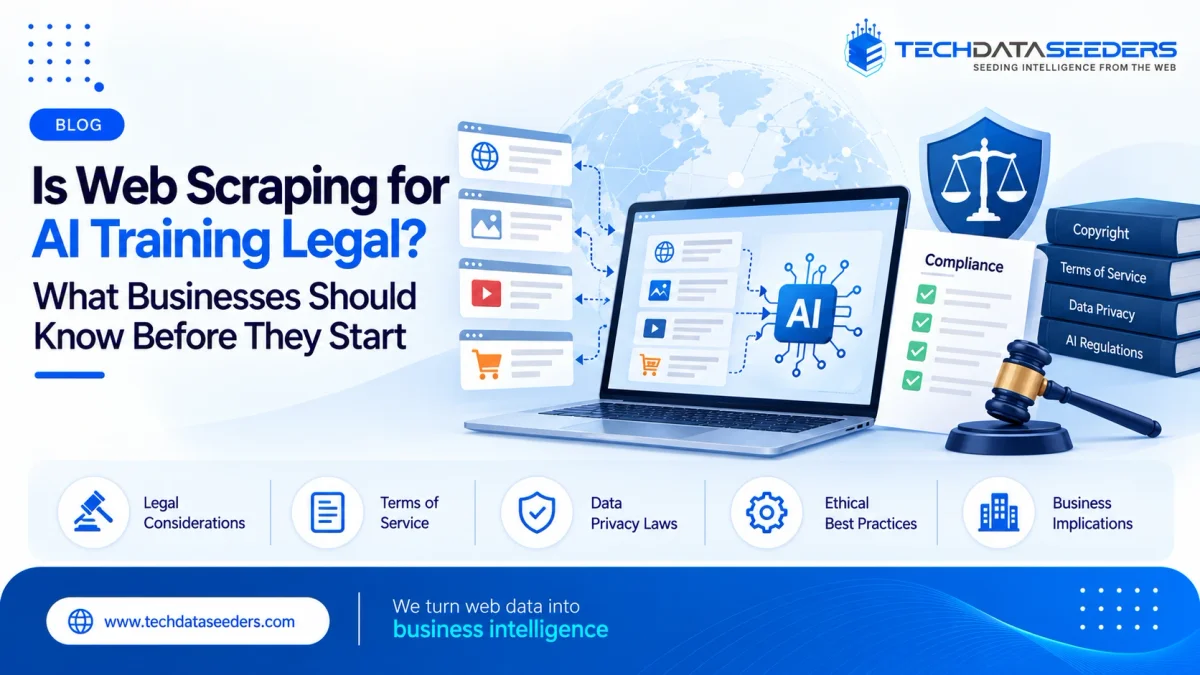
Is Web Scraping for AI Training Legal?
Web Scraping for AI Training data collection and high quality datasets can be lawful in some circumstances, but there is no universal rule that makes all AI-related scraping legal. Businesses need to consider copyright, privacy, contractual restrictions, data-protection obligations, and applicable jurisdictional rules. Personal data and copyrighted content require particular care, especially when collected at large scale for model development.
The first distinction businesses should make is between:
- Publicly accessible data
- Personal data
- Copyright-protected content
- Licensed data
- User-generated content
- Public-domain material
Simply being able to access information online does not necessarily answer whether it can legally be collected and used for AI training.
The ICO, for example, states that organisations processing personal data for AI training need an appropriate lawful basis and must determine that basis before processing begins.
Web Scraping and Copyright: Can Copyrighted Content Be Used for AI Training?
Web scraping and copyright are separate from simply accessing information online. A website may make content publicly available while the underlying text, images, videos, code, or other creative works remain protected by copyright. Whether copying and using that material for AI training is lawful depends on the applicable copyright law and circumstances of the use.
This is one of the areas where businesses should avoid making broad assumptions.
For example, a dataset containing:
- News articles
- Books
- Product photographs
- Illustrations
- Videos
- Blog posts
- Software code
may contain copyright-protected works.
In the United States, fair use is assessed using four statutory factors, including the purpose and character of the use, the nature of the copyrighted work, the amount used, and the effect on the potential market. The U.S. Copyright Office notes that these factors require case-specific analysis rather than a mechanical test.
Does Publicly Available Content Mean It Is Free to Use?
No. Publicly accessible does not automatically mean copyright-free.
Businesses should distinguish between:
Can I access this content?
and
Can I legally copy, store, transform, and use this content for AI training?
Those are different questions. That’s where the LLM Training data collection guide comes in.
Where licensing is available, obtaining data through a clear licensing arrangement may provide a more predictable foundation than relying entirely on uncertain legal interpretations.
Web Scraping and Data Privacy: What Changes When Personal Data Is Involved?
Enterprise Web scraping and data privacy become closely connected when scraped information identifies or can reasonably be linked to individuals. Names, email addresses, photographs, usernames, location information, posts, and other identifiers may constitute personal data depending on the applicable law and circumstances.
This means a dataset can create privacy obligations even when the information was originally visible on a public website.
The EDPB's 2026 guidance states that GDPR can apply to web scraping when it involves processing personal data, including collection, storage, organisation, and retrieval. It also highlights purpose limitation, transparency, data minimisation, accuracy, and lawful basis requirements.
Why Public Personal Data Still Requires Attention
Consider a public profile containing:
- Name
- Professional information
- Location
- Photograph
- Public comments
The fact that someone posted this information publicly does not necessarily eliminate data-protection obligations when another organisation collects it and repurposes it for AI training.
The ICO specifically notes that people may not reasonably expect information they provided for one purpose to later be scraped and used to train a generative AI model.
GDPR Web Scraping: What Should AI Businesses Consider?
GDPR web scraping requires businesses to assess whether their collection and subsequent processing of personal data has a valid legal basis and satisfies applicable GDPR requirements. Purpose limitation, transparency, data minimisation, accuracy, individual rights, and safeguards should be considered before using scraped personal data for AI training.
The EDPB's 2026 guidance places particular emphasis on these issues in the context of generative AI.
Businesses should therefore ask:
1. What personal data is being collected?
2. Why is it being collected?
3. What lawful basis applies?
4. Is the collection necessary for the stated purpose?
5. Can less intrusive data sources be used?
6. How will individuals be informed?
7. How will data-subject rights be handled?
8. Are special categories of personal data involved?
The EDPB also recommends collecting from reliable sources, recording timestamps, validating data before AI training, and applying data-minimisation measures.
GDPR Web Scraping and Legitimate Interests
Legitimate interests can potentially be relevant, but businesses should not treat it as a blanket permission to scrape.
The ICO's current position is that legitimate interests are realistically the lawful basis developers may explore for web-scraped personal data used to train generative AI, but developers still need to satisfy the relevant three-part test, including purpose, necessity, and balancing.
CCPA Web Scraping: What Businesses Need to Check?
CCPA web scraping requires businesses handling California residents' personal information to assess whether their collection and use falls within the California privacy framework and what obligations apply. The analysis depends on the organisation, the information involved, the purpose of collection, and the specific CCPA/CPRA requirements that apply to the business.
For businesses operating in California-related data environments, useful questions include:
- Does the collected information qualify as personal information?
- Whose information is being collected?
- What is the purpose of the collection?
- What disclosures are required?
- Are applicable consumer rights involved?
- Is the information being shared with another organisation?
- Does the business have appropriate data-governance processes?
The important point is that CCPA web scraping should be assessed as a privacy and data-governance issue, rather than assuming that publicly available information is outside the scope of privacy obligations.
What Are AI Data Scraping Laws Businesses Should Know?
AI data scraping laws are not governed by one universal global rule. Businesses may need to consider different copyright, privacy, consumer-protection, database, contractual, and AI-related requirements depending on where the data originates, where the organisation operates, and how the dataset and resulting AI system are used.
This creates a practical challenge for businesses collecting data internationally.
A dataset may contain information from:
- The European Union
- United States
- United Kingdom
- Asia-Pacific markets
- Multiple international platforms
Each jurisdiction can introduce different considerations.
Therefore, an enterprise should map:
Source → Data Type → Jurisdiction → Purpose → Processing → AI Use
before designing a large-scale collection strategy.
Ethical Web Scraping for AI: What Should Responsible Collection Look Like?
Ethical web scraping for AI means collecting and using web data in a way that considers legal requirements, individual rights, source expectations, data quality, transparency, and potential downstream harm. Responsible scraping goes beyond asking whether data can technically be collected and instead asks whether the collection and intended AI use are appropriate.
A responsible approach can include:
Collect Only What You Need
Avoid collecting unnecessary personal information simply because it is technically accessible.
Prefer Reliable Sources
The EDPB recommends using reliable sources and validating information before using it for AI training.
Respect Applicable Restrictions
Businesses should review:
- Website terms
- Licensing conditions
- Copyright restrictions
- Privacy requirements
- Applicable access restrictions
Keep Data Provenance
Maintain records of:
- Source URL
- Collection date
- Dataset version
- Data category
- Processing purpose
This can make later compliance reviews considerably easier.
Build Transparency Into the Process
The ICO has highlighted transparency as a significant concern in generative-AI development involving web-scraped data.
Does Website Terms of Service Affect AI Data Scraping?
Yes. Website terms of service can be relevant to AI data scraping because contractual restrictions may govern how a website's content or services can be accessed and used. Terms should therefore be reviewed alongside copyright and privacy requirements rather than treating scraping as purely a technical activity.
A business should distinguish between:
Copyright rights
Who owns the underlying creative work?
Privacy rights
Does the data identify individuals?
Contractual restrictions
What terms govern access or use?
Technical restrictions
Are there controls governing automated access?
These can involve different legal questions, so businesses should not assume that compliance with one automatically resolves the others.
How Can Businesses Build a Legally Safer AI Training Dataset?
With Custom data api Businesses can reduce legal and compliance risks by defining the intended AI purpose first, identifying what types of data are actually necessary, assessing copyright and privacy requirements, documenting data sources, and considering licensed or permission-based datasets where appropriate.
A practical workflow is:
Define AI purpose → Identify required data → Classify data → Assess legal requirements → Select sources → Collect responsibly → Validate → Document provenance → Review before training
Where personal data is involved, the organisation should also consider appropriate privacy controls and individual rights.
For high-risk or uncertain use cases, legal advice should be obtained before large-scale collection begins.
Should Businesses Use Licensed Data Instead of Web Scraping?
Yes. Licensed data can provide businesses with greater clarity around permitted use, although licensing does not automatically resolve every legal or technical issue. Where the intended use involves large quantities of copyrighted or personal information, a properly negotiated dataset licence may provide a more predictable foundation than relying solely on assumptions about public accessibility or legal exceptions.
The ICO notes that alternative data-collection methods, including datasets licensed directly by publishers, may be available and encourages developers to consider whether web scraping is actually necessary.
For some AI projects, the most appropriate strategy may therefore be a combination of:
- Licensed datasets
- Public-domain content
- First-party data
- Synthetic data
- Carefully assessed web data
What Should Businesses Document Before Starting Web Scraping for AI Training?
Before beginning Web Scraping for AI Training, businesses should document the purpose of collection, source categories, types of data collected, jurisdictions involved, applicable legal assessments, data-processing activities, retention approach, and intended AI use. Maintaining this information creates a clear record of how the training dataset was created and why specific data sources were selected.
A useful dataset record can include:
| Information | Example |
|---|---|
| Source | Website/domain |
| Collection date | Timestamp |
| Data type | Product/article/profile |
| Personal data | Yes/No |
| Copyright status | Assessed |
| Legal basis | Documented |
| Purpose | AI model training |
| Processing | Cleaning/filtering |
| Dataset version | v1.2 |
This becomes particularly valuable when datasets are large and involve thousands or millions of records.
How Techdataseeders Can Support AI Data Collection?
Techdataseeders can support businesses with structured web data collection for AI and machine-learning workflows, including data extraction, processing, cleaning, validation, and structured delivery. However, businesses remain responsible for determining whether their intended collection and use of data complies with applicable laws, licences, website terms, and privacy obligations.
A responsible AI data workflow can include:
Source identification → Data extraction → Cleaning → Validation → Structured dataset delivery
The technical collection layer should therefore be combined with the organisation's own legal and data-governance review.
Conclusion
Web Scraping for AI Training is a legal and compliance issue as much as it is a technical one. Businesses should not assume that publicly accessible information is automatically available for AI training. Copyright, personal data, privacy laws, contractual restrictions, jurisdiction, purpose, and data provenance all need to be considered before collection begins.
The safest approach is to define the AI use case, classify the data, assess applicable laws, document sources, minimise unnecessary data collection, and use licensed or permission-based sources where appropriate.
This article is intended for general information and is not legal advice. AI data-scraping requirements can vary by jurisdiction and use case, so businesses should obtain advice from qualified counsel for specific projects.
FAQs
No. Public accessibility does not automatically remove copyright, privacy, contractual, or other legal considerations. Web Scraping for AI Training should be assessed based on the type of data, purpose, jurisdiction, source restrictions, and intended use.
Not necessarily in every situation, but businesses need an appropriate legal basis where applicable. For web scraping and data privacy, organisations should determine the relevant lawful basis and assess transparency, necessity, individual rights, and other requirements before processing personal data.
Public availability does not automatically make personal-data processing exempt from GDPR. GDPR web scraping involving personal data may still require a lawful basis and compliance with principles such as purpose limitation, transparency, data minimisation, and accuracy.
Potentially, depending on the information, business, consumer, and applicable CCPA/CPRA provisions. CCPA web scraping should therefore be assessed based on the specific data and processing activity rather than assuming that publicly accessible information is automatically outside privacy obligations.
It depends on the applicable copyright law and circumstances. Web scraping and copyright should be evaluated based on factors such as the purpose of use, nature of the work, amount used, market effects, licensing, and relevant legal exceptions. In the U.S., fair use is a fact-specific analysis.
Ethical web scraping for AI involves collecting only necessary data, respecting applicable rights and restrictions, using reliable sources, maintaining data provenance, validating datasets, and providing appropriate transparency. Ethical collection should complement—not replace—formal legal and privacy assessments.
No. AI data scraping laws can differ significantly between jurisdictions. Copyright, privacy, consumer-protection, contractual, and AI-related requirements may apply differently depending on where the source, individuals, business, and AI system are located or used.