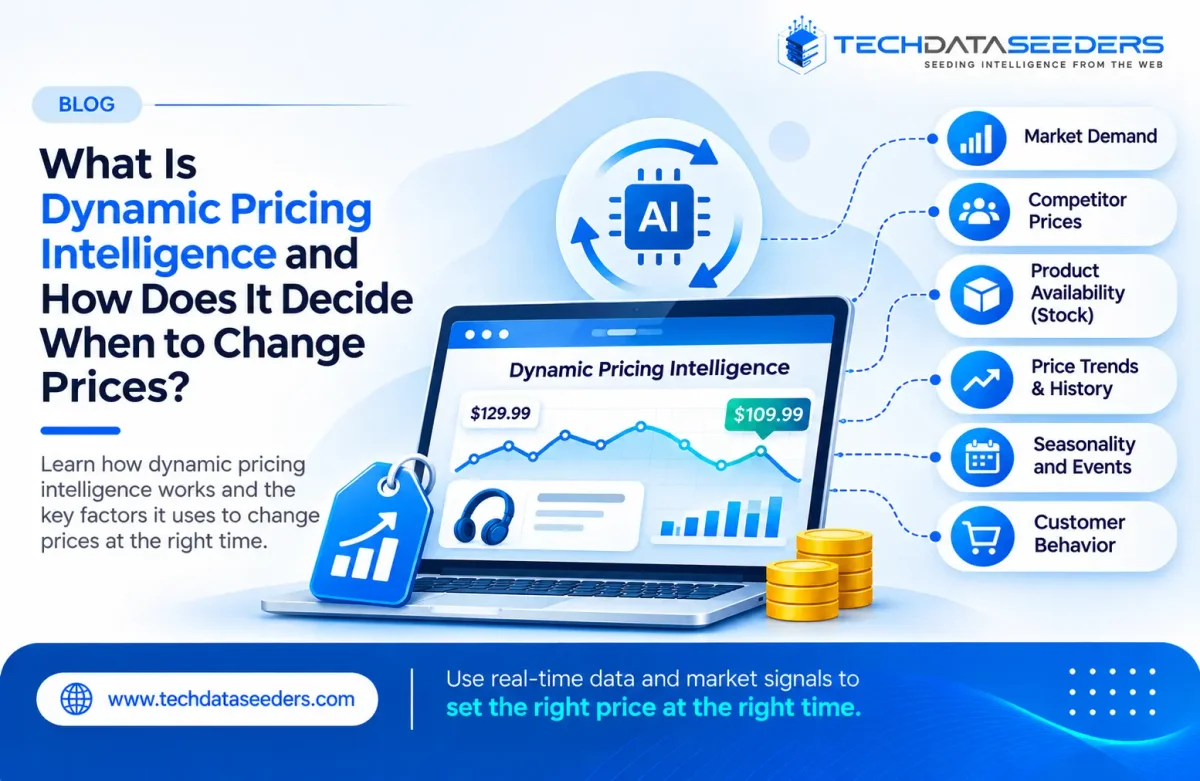
Dynamic pricing intelligence helps businesses understand market conditions by collecting and organizing relevant pricing, product, seller, and availability information. This data can support pricing teams and the systems they use to make informed decisions.
Techdataseeders provides structured ecommerce data collection and competitor price monitoring workflows that can supply the external market data layer for dynamic pricing programs.
What Is Dynamic Pricing Intelligence?
Dynamic pricing intelligence is the use of market and competitor data to inform pricing decisions as conditions change.
It can include:
- Competitor advertised prices.
- Product and variant matching.
- Promotions and discounts.
- Seller and marketplace information.
- Product availability.
- Price history and movement.
- Market and currency context.
Dynamic pricing intelligence is not necessarily an automated repricing engine. Data collection and intelligence provide inputs; a retailer's pricing rules, analytics, or software determine how those inputs are used.
How Does a Dynamic Pricing Intelligence System Work?
A Dynamic Pricing Intelligence System collects pricing and market data, evaluates that information against business objectives, and produces price recommendations or approved price updates. Depending on its configuration, the system may support human approval or connect directly to pricing platforms for automated execution.
Most systems follow a workflow with five main stages.
1. Collect Product and Competitor Pricing Data
The system first gathers product pricing information from relevant ecommerce websites and marketplaces. This may include product prices, seller offers, discounts, availability, and product identifiers.
For example, a US retailer selling home appliances may monitor:
- Amazon product prices
- Walmart marketplace offers
- Best Buy appliance listings
- Home Depot product prices
- Competitor brand websites
A structured data collection process helps pricing teams understand how similar products are priced across different retailers.
2. Match Equivalent Products Across Retailers
Before comparing prices, the system needs to identify whether the products being monitored are genuinely equivalent.
A television listed as a 55-inch 4K model on one website may have a different title on another. Product matching can use brand names, model numbers, UPCs, GTINs, and variant attributes to identify corresponding products.
This step is important because comparing different models, storage capacities, sizes, or product bundles can produce misleading pricing recommendations.
3. Analyze Market and Business Signals
Once the data is collected and matched, the system evaluates pricing signals.
These may include:
- Competitor price differences
- Historical price trends
- Sales velocity
- Product demand
- Inventory levels
- Promotional calendars
- Cost and margin requirements
For example, if a retailer sees a competitor reducing the price of a laptop, the system can check whether the retailer has sufficient inventory, whether demand is increasing, and whether a price reduction would affect its target margin.
4. Generate a Price Recommendation
The system applies pricing rules, analytical models, or AI-powered predictions to recommend a suitable price.
A recommendation may consider:
- Minimum acceptable selling price
- Target profit margin
- Competitor price range
- Current demand
- Inventory availability
- Promotional objectives
The output may be a suggested price, a recommended percentage adjustment, or a decision to maintain the existing price.
5. Approve and Apply the Price Change
The final stage determines whether the recommendation requires human approval or can be executed automatically.
For example, a pricing team may review recommendations for high-value products, while approved pricing rules may automatically update prices for selected low-risk products.
A controlled approval process helps businesses avoid unexpected price changes caused by inaccurate data or unsuitable recommendations.
What Factors Decide When a Business Should Change Its Prices?
A business should consider changing a price when relevant market or operational signals indicate that the current price may no longer support its commercial objectives. Dynamic Pricing Intelligence evaluates several factors together instead of responding to one competitor price or demand change in isolation.
The following signals commonly influence pricing decisions.
1. Competitor Price Intelligence
Competitor price intelligence helps businesses understand how competing retailers price equivalent products. It provides visibility into competitor price changes, promotional offers, seller activity, and market positioning.
For example, a US electronics retailer may track a laptop across Amazon, Walmart, and Best Buy.
| Retailer | Observed product price |
|---|---|
| Retailer A | $899 |
| Retailer B | $879 |
| Retailer C | $929 |
These illustrative prices show that the product is available at different price points. A pricing system can compare the retailer's own price with the observed competitor range and determine whether a change deserves consideration.
However, the lowest competitor price is not necessarily the correct target. Shipping costs, seller reliability, product condition, warranties, and promotional eligibility may affect whether two offers are genuinely comparable.
2. Customer Demand and Sales Velocity
Demand indicates how strongly customers are purchasing a product. Sales velocity measures how quickly units are selling over a specific period.
For example, if a US retailer notices that a particular air purifier is selling faster during allergy season, the system may identify an opportunity to review its current price.
Demand analysis can consider:
- Units sold per day or week
- Conversion rate
- Product page activity
- Historical sales patterns
- Seasonal demand changes
Strong demand may create room to maintain or adjust prices, while weakening demand may encourage promotional testing. These decisions should also account for competition, costs, and inventory.
3. Inventory Availability
Inventory levels can influence whether a business should maintain, increase, or reduce a product's price.
For example:
- High inventory with slow sales may justify a promotional review.
- Limited inventory with strong demand may support maintaining the current price.
- Seasonal products approaching the end of their selling period may require clearance planning.
A pricing system should use reliable internal inventory information where available. Competitor product availability can provide additional market context, but a displayed stock status does not necessarily reveal exact inventory quantities.
4. Historical Price Trends
Historical pricing data helps businesses understand whether current market prices represent normal conditions or unusual changes.
For example, a retailer may discover that a competitor frequently reduces a product's price during weekend promotions. Instead of reacting to every reduction, the pricing team can evaluate whether the current change follows an established pattern via retail price Monitoring Software.
Historical price analysis can include:
- Previous selling prices
- Average observed prices
- Highest and lowest observed prices
- Frequency of price changes
- Discount duration
- Seasonal pricing patterns
This context helps businesses avoid making decisions based on isolated price observations.
5. Profit Margins and Product Costs
A price change should support business profitability, not just improve competitive positioning.
A dynamic pricing system can evaluate product cost, shipping expenses, marketplace fees, promotional costs, and target margins before recommending an adjustment.
For example, reducing a product's selling price by $10 may improve competitiveness but could leave insufficient margin after marketplace fees and fulfillment expenses.
Businesses should establish minimum margin thresholds and pricing boundaries so that recommendations remain commercially acceptable.
6. Seasonal Trends and Promotional Activity
Seasonal events and promotional campaigns can create temporary changes in demand and competitor pricing.
For US ecommerce retailers, relevant periods may include:
- Black Friday
- Cyber Monday
- Christmas shopping
- Back-to-school sales
- Prime Day
- Memorial Day promotions
A Black Friday and Cyber Monday competitor price monitoring system can compare current prices with historical promotional activity and help teams plan when to introduce, maintain, or end discounts.
Important Data Fields for Dynamic Pricing Intelligence
| Field | Description |
|---|---|
| Internal Product ID | Client's product identifier |
| Competitor Product ID | Source product identifier, where available |
| Brand | Product brand |
| Product Title | Displayed product title |
| GTIN / EAN / UPC | Standard product identifier |
| MPN / Model | Manufacturer part number or model |
| Product URL | Competitor listing URL |
| Competitor / Marketplace | Source website |
| Seller Name | Seller displayed on the listing |
| Market | Country or region |
| Current Price | Observed price |
| Currency | Price currency |
| Original Price | Displayed reference or crossed-out price |
| Discount | Displayed discount, where available |
| Promotion | Offer or promotional text |
| Availability | Displayed stock status |
| Match Status | Matched, unmatched, or review required |
| Match Confidence | Agreed confidence score or category |
| Collected At | Observation timestamp |
Additional fields can be added for shipping, taxes, delivery estimates, product ratings, and other source-visible information when required.
Example: Competitor Price Intelligence Dataset
The following sample is illustrative and shows how matched observations can be organized.
| Internal Product | Competitor | Competitor Price | Currency | Availability | Match Status |
|---|---|---|---|---|---|
| SKU-1001 | Store A | 89.99 | USD | In stock | Matched |
| SKU-1001 | Store B | 92.50 | USD | In stock | Matched |
| SKU-1002 | Store A | 145.00 | USD | Out of stock | Review |
Illustrative data only. Prices and availability are not live observations.
A useful dataset retains the source URL and timestamp so that pricing teams can investigate the observation and understand when it was collected.
How Techdataseeders Supports Competitor Price Intelligence
Techdataseeders helps businesses collect and structure ecommerce data that can support competitor price intelligence and dynamic pricing workflows. Reliable pricing decisions depend on having consistent information about product listings, competitor offers, displayed prices, and historical market changes.
Relevant data collection requirements may include:
- Ecommerce product price extraction
- Competitor product listing collection
- Marketplace seller offer monitoring
- Product identification and matching
- Historical price data collection
- Scheduled data extraction
- Data cleaning and structured delivery
- Custom data pipelines and API integration
For example, a US retail business monitoring electronics across Amazon, Walmart, and Best Buy may need regularly collected product prices and listing information in a standardized format. This data can then be connected to internal analytics or pricing systems via retail competitive intelligence.
Conclusion
Dynamic Pricing Intelligence helps businesses make informed pricing decisions by combining competitor price intelligence, historical data, demand signals, inventory information, and business rules. It allows retailers to understand when a price change may be appropriate rather than relying entirely on manual reviews or reacting to isolated competitor discounts.
AI-powered dynamic pricing can add predictive analysis, while automated dynamic pricing can help execute approved rules at scale. However, reliable results depend on accurate data, suitable product matching, clear margin boundaries, and continuous performance monitoring.
Build a Stronger Market View with Techdataseeders
Dynamic pricing decisions depend on reliable market inputs. Structured competitor data can help your team understand price positioning, promotions, seller activity, and product availability across agreed online sources.
Techdataseeders can help define the data scope, match competitor products, collect price observations, and deliver structured datasets for your analytics or pricing workflows.
FAQs
Dynamic Pricing Intelligence can use competitor prices, product identifiers, historical price observations, customer demand, sales performance, inventory levels, product costs, and promotional information. The required data depends on the business's pricing objectives and the complexity of its pricing model.
Competitor price intelligence helps businesses understand how similar products are priced across different retailers. Pricing teams can use this information alongside internal costs, margins, demand, and inventory to decide whether to maintain, increase, or reduce their own prices.
AI-powered dynamic pricing can analyze historical competitor price movements and identify recurring patterns that may help estimate future pricing activity. However, it cannot guarantee that a competitor will make a particular price change.
Automated dynamic pricing can benefit small ecommerce businesses when they have a manageable product catalogue and clear pricing rules. They can begin with competitor price monitoring, minimum-margin thresholds, and basic automated recommendations before introducing more advanced models.
A dynamic pricing intelligence system should evaluate prices according to product category, market activity, and business requirements. Some products may need several daily checks, while others may only require daily or weekly reviews. Price updates should also follow appropriate approval and margin controls.
Dynamic pricing adjusts a product's price based on market or business conditions, such as demand, inventory, and competitor activity. Personalized pricing refers to pricing that varies based on individual customer-related factors. The two approaches have different implications and should not be treated as interchangeable.
Retailers can establish minimum margin thresholds, approved price ranges, maximum adjustment limits, and rules for reviewing unusual competitor offers. Combining competitor price intelligence with product costs and internal sales data helps prevent pricing decisions from focusing only on the lowest available market price.