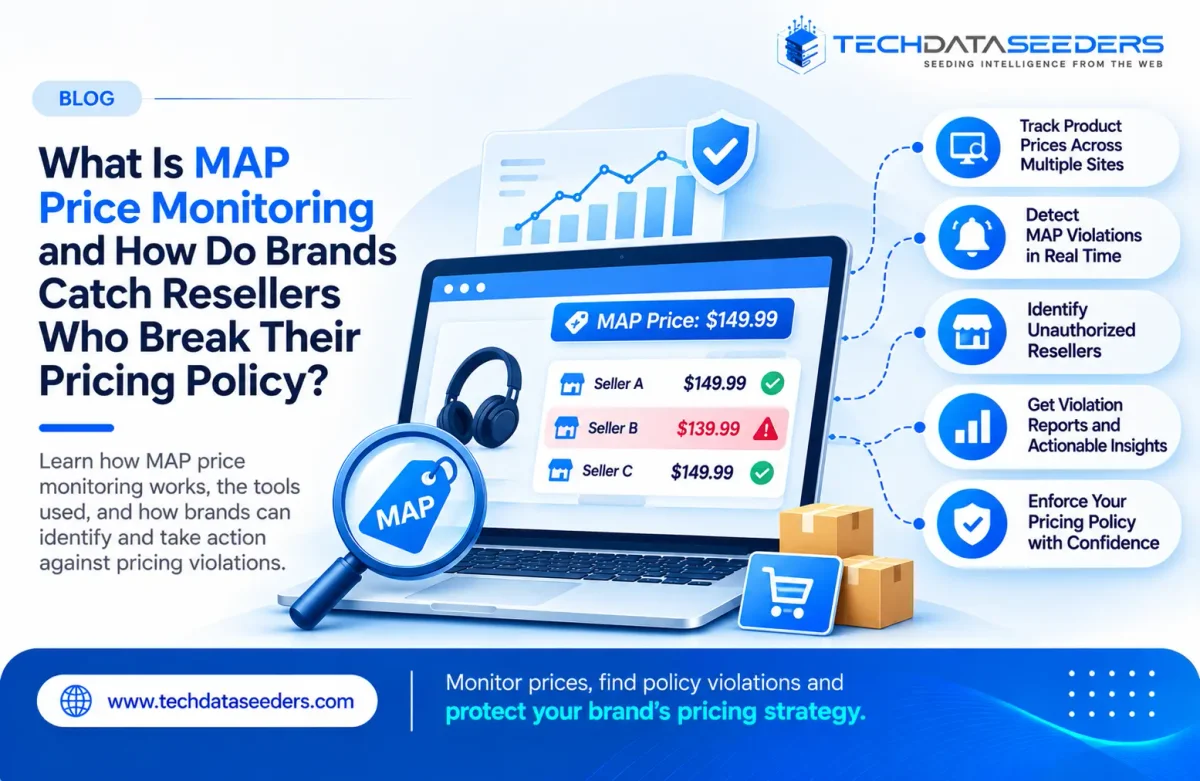
Techdataseeders supports market intelligence and ecommerce data collection workflows that help brands monitor product listings, seller information, and advertised prices across agreed online sources.
What Is a Minimum Advertised Price (MAP) Policy?
A Minimum Advertised Price (MAP) policy is a brand-established policy that specifies the lowest price at which participating resellers may advertise a product. It is generally intended to protect brand positioning and reduce public price competition between resellers, while allowing the brand to define how its advertised pricing policy is administered.
For example, a US home appliance manufacturer may establish a MAP price of $249 for a particular coffee machine. Participating resellers covered by the policy may be restricted from advertising the product below that amount under the policy's terms.
A MAP policy generally concerns the advertised price, not necessarily the final price at which a customer completes a purchase. Depending on the policy, certain private offers, negotiated prices, or checkout discounts may be treated differently.
A MAP policy should clearly explain:
- Which products are covered
- Which resellers or sales channels are covered
- The applicable advertised price for each product
- How promotional pricing is handled
- Whether shipping or other charges affect the advertised price
- How violations are identified and reviewed
- What consequences may apply under the policy
Brands should have qualified legal counsel review their MAP policies and enforcement processes. In the United States, MAP policies can raise antitrust considerations, and a unilateral pricing policy should not be confused with an agreement between a supplier and reseller about resale prices.
Why Do Brands Need MAP Price Monitoring?
MAP price monitoring helps brands identify advertised prices that may fall below their established pricing thresholds. Without consistent monitoring, brands may struggle to identify reseller activity across multiple marketplaces, independent websites, and regional online stores.
For example, a US audio equipment manufacturer may have hundreds of authorized resellers. Manually checking every product listing across Amazon, Walmart, and specialist electronics retailers can become difficult as the reseller network grows.
A structured monitoring process offers several benefits.
1. Protecting Brand Price Positioning
Frequent below-MAP advertising can affect how customers perceive a product's value. If customers repeatedly see a premium product advertised at significantly lower prices, the brand may find it harder to maintain consistent market positioning.
MAP monitoring helps brands identify these pricing patterns and investigate where they are occurring.
2. Improving Reseller Compliance Visibility
Brands often work with multiple authorized resellers, distributors, and marketplace sellers. Reseller price monitoring provides a consolidated view of how covered products are being advertised across these channels.
It can help identify:
- Resellers repeatedly advertising below MAP
- Products with frequent price discrepancies
- Marketplace listings with unclear seller identities
- Geographic or channel-specific pricing patterns
- Resellers requiring further compliance review
3. Identifying Unauthorized or Unfamiliar Sellers
A brand may encounter product listings from sellers that are not immediately recognizable within its authorized reseller network.
MAP monitoring can help identify these sellers and collect relevant listing information for further investigation. However, a low advertised price alone does not establish that a seller is unauthorized or that a product is counterfeit.
4. Reducing Manual Price Checks
A large reseller network can generate thousands of product listings across different websites. Automated MAP price tracking helps reduce repetitive manual checks by collecting advertised prices and comparing them against defined policy thresholds.
This allows compliance and channel teams to focus on investigating meaningful exceptions rather than checking every listing individually.
5. Maintaining Better Pricing Records
Historical price records help brands understand whether a reseller's low advertised price is an isolated event or part of a recurring pattern.
Brands can use these records to review price changes, document observations, and evaluate compliance trends over time.
Key Data Fields for MAP Price Monitoring
| Field | Description |
|---|---|
| Brand | Product brand |
| Product Name | Displayed product title |
| GTIN / UPC / EAN | Product identifier, where available |
| MPN / Model | Manufacturer part number or model |
| Product URL | Retailer listing URL |
| Retailer / Marketplace | Website where the listing appears |
| Seller Name | Seller displayed on the listing |
| Market | Country or region |
| Advertised Price | Observed listed price |
| Currency | Price currency |
| MAP Price | Applicable reference threshold |
| Price Difference | Observed price compared with MAP |
| Promotion Text | Displayed offer or discount text |
| Availability | Displayed stock status |
| Match Confidence | Confidence or status of product matching |
| Observation Timestamp | Date and time collected |
| Evidence Reference | URL or agreed evidence record |
The final schema should be aligned with the brand's policy definitions and reporting requirements.
Example: Identifying Potential MAP Exceptions
The following example is illustrative and assumes the product, market, currency, and MAP reference have already been validated.
| Product | Seller | Advertised Price | MAP Reference | Review Flag |
|---|---|---|---|---|
| Model A | Retailer One | $94.99 | $99.99 | Review |
| Model B | Retailer Two | $129.99 | $129.99 | No price difference |
| Model C | Retailer Three | $149.00 | $159.00 | Review |
A review flag indicates that the observed advertised price is below the reference value. It does not, by itself, establish a policy violation. The brand should assess applicable exceptions, policy wording, market rules, and evidence.
How Does MAP Violation Detection Identify Resellers Breaking Pricing Policies?
MAP violation detection identifies potential policy breaches by comparing collected reseller prices against product-specific MAP thresholds and applying additional checks to determine whether the observed listing falls within the policy's scope.
A reliable detection process should not depend on price comparison alone. Learn how price intelligence software helps spot MAP violations.
1. Product-Level Price Comparison
The system checks whether the advertised price is below the MAP value assigned to the matched product.
For example, if a brand's MAP price for a camera is $299 and a reseller advertises it for $279, the system can flag the listing for review.
2. Seller Identification
The monitoring system records the seller or reseller associated with the listing.
This is especially important on marketplaces where several sellers may offer the same product at different prices.
A brand may need to distinguish between:
- Authorized resellers
- Marketplace sellers
- Third-party distributors
- Unfamiliar or unidentified sellers
Seller identification should be validated where possible because marketplace seller information may change or be incomplete.
3. Promotional Price Checks
Some listings display discounts, coupons, promotional codes, or checkout offers.
For example, a product may display a regular price of $199 while a coupon reduces the amount shown to customers.
The brand must evaluate how its MAP policy treats these promotional formats. A monitoring system should capture the displayed offer details instead of automatically treating every discount mechanism in the same way.
4. Repeated Violation Pattern Detection
A single below-MAP observation may require investigation, but repeated observations can provide a clearer picture of reseller pricing behaviour.
A monitoring system can track:
- Number of below-MAP observations
- Duration of the price discrepancy
- Frequency of price changes
- Products affected
- Resellers associated with repeated alerts
- Historical compliance patterns
This helps brands prioritize recurring issues rather than treating every alert as equally significant.
5. Evidence Collection
Each potential violation should be supported by a record of what was observed.
Useful evidence may include:
- Original product URL
- Timestamped price observation
- Product identifier
- Seller details
- Screenshot or captured page evidence, where permitted
- Promotional terms visible on the listing
Maintaining these records makes it easier for teams to investigate and document potential policy violations.
How Techdataseeders Supports MAP Price Monitoring and Reseller Price Monitoring
Techdataseeders helps businesses collect and structure ecommerce data that can support MAP price monitoring, reseller pricing analysis, and competitor price monitoring. Brands can use structured product and pricing information to identify potential below-MAP listings and provide their compliance teams with records for further investigation.
Relevant data collection requirements may include:
- Ecommerce price tracking
- Reseller listing monitoring
- Marketplace seller information collection
- Product identification and matching
- Scheduled MAP price tracking
- Historical advertised-price records
- Structured data validation and delivery
- Custom data pipelines and API integration
For example, a US consumer electronics brand monitoring authorized reseller listings across Amazon, Walmart, and specialist retail websites may need product-level price observations, seller details, listing URLs, and collection timestamps.
These records can be connected to internal compliance tools or reporting dashboards to support potential MAP violation detection and review workflows.
MAP and reseller checks are part of our retailer price monitoring service for brands.
Conclusion
MAP Price Monitoring helps brands maintain visibility into how their products are advertised across reseller websites and online marketplaces. By combining automated price collection, accurate product matching, MAP violation detection, and structured alerts, brands can identify potential policy breaches and investigate them more efficiently.
A reliable process should go beyond detecting a price below a threshold. It should also preserve listing evidence, account for promotional conditions, identify the relevant seller, and follow the brand's documented policy and legal review process.
Improve Retail Price Visibility with Techdataseeders
A consistent MAP monitoring process starts with accurate product matching, reliable price observations, and a clear review workflow.
Techdataseeders can help collect structured ecommerce listing and pricing data across agreed online sources, giving brand teams a clearer view of advertised prices and potential exceptions.
FAQs
MAP price monitoring checks whether reseller-advertised prices fall below a brand's specified MAP thresholds. Regular competitor price tracking focuses more broadly on comparing product prices across competing retailers, regardless of whether a MAP policy applies.
Brands can monitor product listings on Amazon and Walmart, match them with their product catalogue, identify the seller, and compare observed advertised prices against applicable MAP thresholds. Potential discrepancies can then be reviewed against the relevant policy terms and promotional conditions.
MAP price tracking frequency depends on the number of products, reseller network size, marketplace activity, and business requirements. Frequently changing products may need several checks per day, while other products may only require daily or periodic monitoring.
A MAP violation alert should include the product name, product identifier, reseller or seller, observed advertised price, applicable MAP threshold, price difference, original listing URL, and collection timestamp. Promotional details and supporting evidence can also help teams investigate the observation.
MAP violation detection can help identify unfamiliar sellers advertising a brand's products across marketplaces and independent websites. However, determining whether a seller is unauthorized requires checking the brand's reseller records and other relevant information.
Brands can reduce false alerts by using accurate product identifiers, matching the correct product variants, validating seller information, checking promotional conditions, and ensuring that the correct MAP threshold is applied. Human review is important before treating an alert as a confirmed policy violation.
Historical MAP price tracking helps brands understand how reseller pricing changes over time. It can reveal recurring below-MAP observations, identify products with frequent pricing discrepancies, and provide timestamped records that support internal compliance reviews.