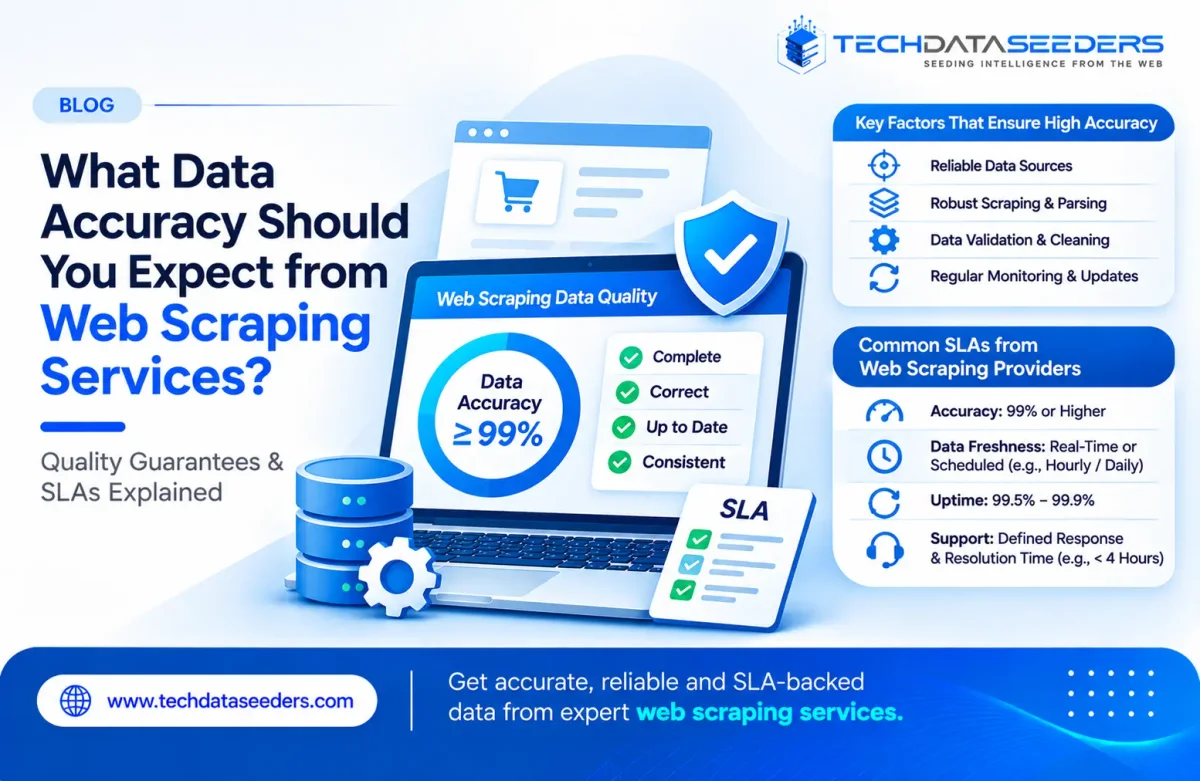
What Does Data Accuracy Mean in Web Scraping Services?
Data accuracy measures how closely an extracted value matches the information displayed by the source at the agreed collection time.
Accuracy must be defined at field level. A product record may have a correct title but an incorrect price, or a correct URL but a missing availability value.
A useful quality framework distinguishes between:
- Accuracy: Whether a populated value matches the source.
- Completeness: Whether required fields are populated when the source provides them.
- Validity: Whether values follow the agreed format, type, and allowed range.
- Consistency: Whether the same entity is represented consistently across records and markets.
- Uniqueness: Whether duplicate records have been identified and handled.
- Freshness: Whether the data was collected within the agreed refresh window.
These dimensions should not be collapsed into one percentage without defining the calculation.
What Data Accuracy Should You Expect from Web Scraping Services?
The expected data accuracy from web scraping services should be based on a measurable benchmark agreed upon before collection begins. Businesses should understand which fields are being evaluated, how incorrect records are counted, how missing source information is handled, and what happens if the agreed quality level is not achieved.
Recommended 96% Accuracy Framework
A 96% accuracy benchmark can be used as a proposed contractual target when the source, fields, matching rules, and validation methodology are agreed in advance.
The benchmark should not be published as an unconditional guarantee unless it has been approved by operations and legal teams and can be consistently measured.
1. Define the Fields Included in the SLA
List each field that will be measured. For an ecommerce monitoring project, fields may include:
| Field | Example Validation |
|---|---|
| Product Name | Compare with the source product title |
| Brand | Check against the displayed brand |
| Product URL | Confirm the correct product page |
| SKU / Product ID | Validate the source identifier |
| Price | Compare value and currency |
| Availability | Compare displayed stock status |
| Product Attributes | Validate agreed attributes such as size or colour |
| Rating | Compare displayed rating where available |
| Review Count | Compare displayed count where available |
| Image URL | Confirm the image belongs to the matched product |
Only fields explicitly included in the project specification should be part of the SLA calculation.
2. Establish the Validation Sample
The sample should represent the delivered dataset and the sources covered by the project.
The validation plan should specify:
- Total records delivered.
- Sample size.
- Sampling method (random, stratified, or source-specific).
- Websites and markets represented.
- Fields included in the check.
- Reference capture time.
- Validation window after delivery.
For multi-market projects, stratified sampling can help ensure that each market, website, and major product category is represented.
3. Compare Values Against the Source
Each sampled field is checked against the source page or an agreed source reference captured at the relevant collection time.
The reviewer should record:
- Delivered value.
- Source value.
- Validation result.
- Error category, if any.
- Evidence or source URL.
- Timestamp of validation.
A value should not be marked incorrect simply because the source changed after collection. The SLA must define the comparison timestamp and the permitted validation window.
How Is Data Extraction Accuracy Measured?
Data extraction accuracy is measured by comparing collected values against verified source information using an agreed validation method. Depending on the project, businesses may evaluate individual fields, complete records, or a combination of both.
A straightforward field-level accuracy calculation is:
Field Accuracy = (Correct Field Values / Total Field Values Checked) × 100
For example, if a validation sample contains 1,000 price fields and 970 match the agreed source information:
(970 / 1,000) × 100 = 97%
The field-level accuracy is 97%.
A record-level calculation may be different. If a record contains ten required fields, the client may consider the entire record correct only when all ten fields meet the agreed criteria.
This distinction matters because a dataset can have high field-level accuracy while still containing a larger number of records with at least one incorrect field.
Common Data Quality Metrics
| Metric | What it measures | Example |
|---|---|---|
| Field accuracy | Correctness of individual values | Correct product prices |
| Record accuracy | Correctness of complete records | All required product fields match |
| Completeness | Presence of required fields | SKU and price are populated |
| Validity | Compliance with expected formats | Price is numeric and currency is identified |
| Uniqueness | Duplicate record control | Duplicate product listings identified |
| Freshness | Timeliness of collected data | Data collected within the agreed schedule |
Not every project needs the same set of metrics. The validation method should reflect how the client intends to use the data.
What Happens If the Accuracy Benchmark Is Not Met?
The SLA should define a clear review and remediation process before production begins.
A practical process may include:
- Step 1: The client submits a validation report within the agreed review window.
- Step 2: Both parties review the sample, source evidence, and error classifications.
- Step 3: Disputed records are reconciled against the agreed source and timestamp.
- Step 4: Confirmed extraction or mapping errors are corrected.
- Step 5: The affected records or agreed sample are revalidated.
- Step 6: The parties document the final result and any remaining source-side exceptions.
Any service credit, reprocessing commitment, payment adjustment, or other commercial remedy must be expressly stated in the signed agreement. It should not be implied by an accuracy percentage alone.
Example: Ecommerce Data Accuracy Validation
The following example illustrates how a validation sample can be reported.
| Metric | Example Result |
|---|---|
| Records delivered | 10,000 |
| Records sampled | 500 |
| Eligible field values checked | 2,500 |
| Correct field values | 2,425 |
| Incorrect or missing eligible values | 75 |
| Calculated field accuracy | 97.0% |
Illustrative figures only. Actual sample size and calculation rules should be agreed for each project.
What Are Web Scraping Quality Standards?
Web scraping quality standards are the agreed rules and validation practices used to ensure extracted data is accurate, complete, consistent, and suitable for its intended use. They define how data should be collected, checked, formatted, and delivered from a web scraping data pipeline.
Businesses should look beyond a provider's claim that it delivers high-quality data and ask what quality checks are actually performed.
Useful standards include:
Field-Level Validation
Each required field should be checked against the corresponding source information.
For example, a product extraction project may validate product names, prices, currencies, URLs, and identifiers independently.
Data Completeness Checks
The provider should verify whether required fields have been captured and identify missing values.
A missing value should be treated differently from an incorrect value. If a website does not publish a product's model number, the provider should not be penalized for failing to extract information that is unavailable, provided the agreed benchmark accounts for such cases.
Duplicate Detection
Repeated records can distort business analysis, particularly when datasets contain thousands or millions of listings.
Duplicate detection rules should identify whether records are genuinely duplicated or represent separate sellers, variants, or observations.
Format and Schema Validation
Delivered data should follow the agreed structure.
For example:
- Prices should use a consistent numeric format.
- Currency should be identified.
- Dates should follow an agreed format.
- Product URLs should be valid and mapped to the correct records.
- Required columns should be present.
- API responses should follow the agreed schema.
Source-Level Verification
A sample of extracted records should be checked against the original source pages.
This helps identify incorrect selectors, mismatched products, missing fields, and unexpected changes in source content.
What Is a Custom Web Scraping SLA?
A Custom Web Scraping SLA is a project-specific agreement that defines the expected service quality, accuracy benchmarks, collection frequency, delivery timelines, responsibilities, and procedures for handling service issues.
Rather than using one generic agreement for every project, businesses should establish an SLA around their actual data requirements.
For example, a US retail company collecting competitor product prices may need daily updates, while a real estate analytics company may require scheduled property listing extraction and periodic data refreshes.
A custom SLA should cover the following areas:
| SLA component | What should be defined |
|---|---|
| Accuracy benchmark | Agreed percentage and calculation method |
| Data scope | Websites, products, fields, and records |
| Collection frequency | Hourly, daily, weekly, or another schedule |
| Delivery timeline | When each dataset or update is delivered |
| Data format | CSV, JSON, Excel, database, or API |
| Completeness rules | Required fields and handling of missing values |
| Validation process | Sampling, field checks, and error handling |
| Issue resolution | How extraction failures are reported and addressed |
| Responsibilities | Client and provider obligations |
| Acceptance criteria | Conditions for approving delivered data |
The agreement should also explain how source website changes, unavailable information, and unexpected access restrictions are handled.
Why Should Accuracy Be Included in a Web Scraping Service Level Agreement?
Accuracy should be included in a Professional web scraping service level agreement because it turns a general quality expectation into a measurable project commitment.
Without a defined benchmark, clients and providers may have different interpretations of what constitutes acceptable data.
For example, a client may expect every product price to be correct, while a provider may calculate quality using only a sample of required fields. The SLA should remove this ambiguity by defining the calculation method and validation criteria before collection begins.
Techdataseeders' 96% accuracy commitment follows this principle: the benchmark is agreed upfront, and if the agreed benchmark is not met, the client doesn't pay.
What Should a Data Delivery SLA Include?
A Data Delivery SLA defines when, how, and in what format extracted data will be delivered. It helps businesses plan their reporting, analytics, and operational workflows around a predictable data supply schedule.
Accuracy and delivery are related but separate commitments. A dataset can meet its accuracy benchmark and still arrive late, while a timely delivery may contain incorrect information.
A data delivery SLA should address:
Delivery Frequency
Specify whether data will be delivered once, daily, weekly, monthly, or through continuous updates.
Delivery Format
Define the expected output, such as:
- CSV or Excel files
- JSON datasets
- Database access
- REST API delivery
- Cloud storage
- Custom data feeds
Delivery Schedule
Specify the expected delivery time, time zone, and reporting period.
Data Schema
Define column names, data types, field formats, identifiers, and required metadata.
Delivery Notifications
Establish how the client will be informed when a dataset is available or when a delivery issue occurs.
Failed Delivery and Recovery
Define how missing files, incomplete transfers, or failed delivery processes will be handled.
A clear delivery SLA helps ensure that data is not only accurate but also available when business teams need it.
How Techdataseeders Ensures Data Accuracy from Web Scraping Services
Techdataseeders focuses on delivering structured web data that businesses can use for analytics, competitor intelligence, pricing analysis, and operational decision-making. Data quality is treated as a measurable project requirement, with accuracy expectations established before the collection process begins.
Our approach can support projects involving:
- Ecommerce product and pricing data
- Competitor price monitoring
- Product catalogue extraction
- Business and company data collection for machine learning
- Real estate listing extraction
- Mobile app data collection
- Custom data extraction and API delivery
Depending on the project requirements, data quality workflows can include:
- 1. Requirement-based extraction: Define the required websites, fields, formats, and accuracy benchmark before collection begins.
- 2. Structured data extraction: Collect information using source-appropriate extraction workflows.
- 3. Data validation: Check extracted values against agreed field requirements and source information.
- 4. Data standardization: Organize records into the requested structure and format.
- 5. Quality assessment: Evaluate the delivered dataset against the agreed accuracy benchmark.
Conclusion
Data Accuracy from Web Scraping Services should be measured through clear benchmarks, reliable validation methods, and defined delivery requirements. Businesses should evaluate more than the volume of records a provider can collect. They should understand whether the extracted information is correct, complete, properly structured, and delivered according to the agreed schedule.
A well-defined custom web scraping SLA helps establish these expectations before a project begins. It also provides a clear process for evaluating quality and addressing delivery or extraction issues.
At Techdataseeders, we stand behind a 96% accuracy guarantee, with the benchmark agreed upfront. If the agreed benchmark is not achieved, the client doesn't pay. With 100M+ pages crawled daily and 75+ platforms monitored, Techdataseeders supports businesses that need structured, reliable web data at scale.
Define a Measurable Data Quality SLA with Techdataseeders
If your business depends on external web data, define quality before scaling collection.
Techdataseeders can work with your team to specify required fields, validation rules, sampling methods, source coverage, and delivery checks for your data collection project.
Discuss Your Data Requirements
FAQs
Good data accuracy in web scraping depends on the project requirements, source complexity, and fields being collected. Businesses should look for a measurable accuracy benchmark with a clearly defined validation method. Techdataseeders offers a 96% accuracy guarantee, with the benchmark agreed upfront.
Data extraction accuracy can be calculated by comparing correctly extracted field values against the total number of field values checked. For example, if 970 out of 1,000 validated values are correct, the field-level accuracy is 97%.
A web scraping service level agreement should define the accuracy benchmark, data fields, collection frequency, delivery schedule, output format, validation process, issue resolution, and acceptance criteria. It should also explain how missing source information and website changes are handled.
Data accuracy measures whether extracted values are correct, while data completeness measures whether all required fields are populated. A dataset may contain every requested field but still have incorrect values, or it may contain accurate values with some fields missing.
A custom web scraping SLA helps businesses establish project-specific expectations for accuracy, collection frequency, data formats, and delivery timelines. It reduces ambiguity between the client and provider by defining measurable quality and service requirements before work begins.
Businesses should evaluate web scraping quality standards based on data accuracy, completeness, consistency, duplicate handling, and delivery frequency. A reliable provider should also define measurable quality benchmarks, validation methods, and error-handling procedures in the SLA. Agreeing on an accuracy target upfront helps ensure the delivered data meets business requirements.
Businesses can define delivery frequency, time zones, file formats, data schemas, notification procedures, and failed-delivery handling in the data delivery SLA. Regular delivery checks and clear communication help ensure datasets arrive in the expected format and schedule.