What Is a Web Scraping Data Pipeline?
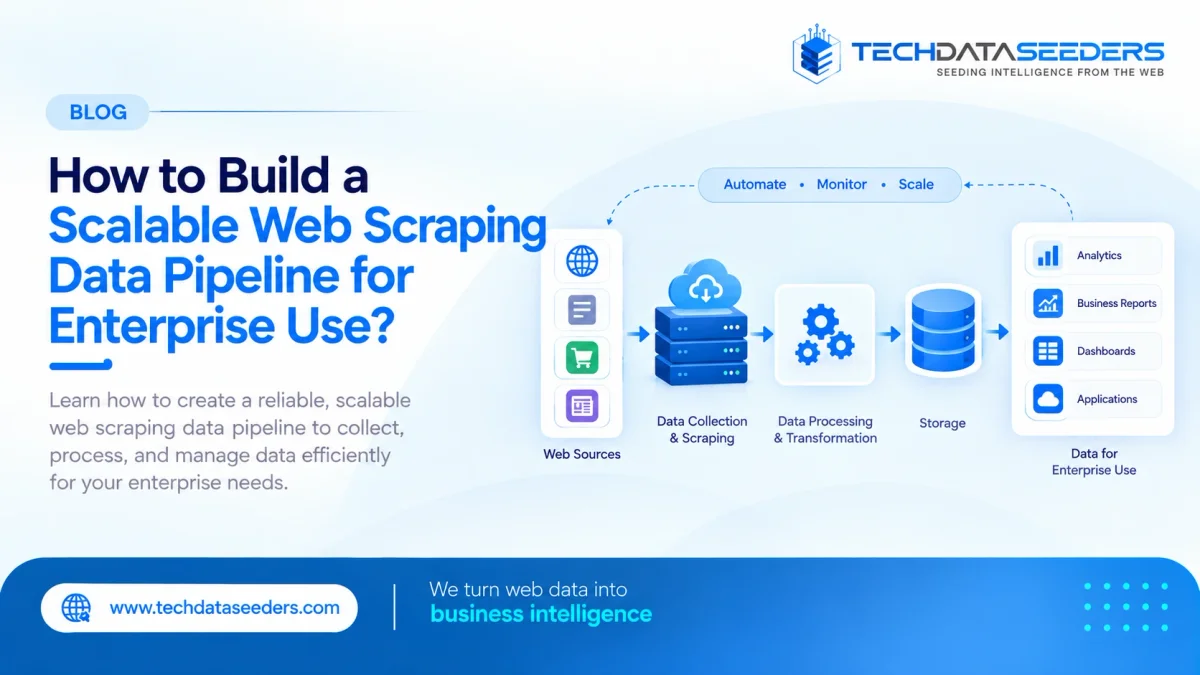
A Web Scraping Data Pipeline is a structured workflow that moves web data from source websites through collection, processing, validation, storage, and delivery. Instead of treating scraping as a single extraction task, an enterprise pipeline creates repeatable stages for turning raw web pages into clean, consistent, and usable business data.
A basic Web Scraping API that simplify Data Pipeline typically looks like this:
Website Sources → Data Collection → Parsing → Cleaning → Validation → Storage → Analytics/API Delivery
The important difference is that an enterprise pipeline is designed for continuous data operations, not just one-time scraping.
For example, a retailer may need to collect:
- Product names
- Prices
- Discounts
- Product availability
- Ratings and reviews
- Seller information
- Product categories
- URLs
- Specifications
The scraper collects the raw information, but the pipeline determines what happens to that information afterward.
That distinction becomes increasingly important as the number of websites, products, categories, and collection schedules increases.
How Does a Web Scraping Data Pipeline Work?
A Web Scraping Data Pipeline works by dividing the complete data extraction process into separate stages, with each stage responsible for a specific task. This makes the workflow easier to scale, monitor, troubleshoot, and modify when source websites or business requirements change.
A typical enterprise workflow includes the following stages:
1. Source Discovery and Configuration
The pipeline first identifies the websites, pages, categories, products, or other sources that need to be monitored.
Configuration can include:
- Target URLs
- Data fields
- Collection frequency
- Geographic requirements
- Pagination rules
- Source-specific extraction logic
2. Data Collection
The collection layer retrieves the required source content according to the configured schedule.
Different websites may require different extraction approaches because their structures, page types, and data availability can vary.
3. Parsing and Extraction
Raw source content is converted into individual fields.
For example:
Raw page → Product name + price + currency + rating + availability
This is where source-specific extraction logic becomes important.
4. Data Cleaning
The extracted information may contain inconsistent formatting, missing values, duplicated records, different currencies, or unwanted characters.
Cleaning transforms these records into a consistent format.
5. Validation
The data validation pipeline checks whether the processed records meet predefined quality rules before they enter the final dataset.
6. Storage
Validated data can be stored in databases, cloud storage, data warehouses, or other systems depending on the business requirement.
7. Delivery
Finally, the structured dataset can be delivered through:
- APIs
- Databases
- Cloud storage
- CSV/JSON/XML files
- Data feeds
- Business intelligence platforms
This staged approach is what makes a Web Scraping Data Pipeline more manageable at enterprise scale.
Building an Enterprise Web Scraping Pipeline That Can Scale
An enterprise web scraping services pipeline should be designed around independent processing stages rather than one large scraping application. Collection, processing, validation, and delivery should be capable of scaling independently so that an increase in one workload does not disrupt the entire data operation.
For example, if product extraction volume increases significantly, the collection layer should be able to handle that additional workload without requiring the entire pipeline to be redesigned.
Separate Collection From Processing
One of the most important design decisions is keeping extraction separate from downstream processing.
Instead of: Scrape → Clean → Store inside one process
An enterprise workflow can use: Collect → Queue → Process → Validate → Store → Deliver
This separation makes failures easier to isolate.
Use Queues Between Major Stages
Data analytics for business queues can help prevent one slow component from blocking the entire workflow.
For example:
Scrapers → Message Queue → Processing Workers → Validation → Storage
If processing temporarily slows down, collected tasks can wait in the queue instead of being lost or forcing the scraper to stop.
Make Components Independently Scalable
A scalable Web Scraping Data Pipeline should allow different components to scale according to demand.
For example:
- More collection workers when source volume increases
- More processing workers when transformation workload increases
- Additional validation capacity when dataset size grows
- More storage capacity as historical data accumulates
This is more practical than simply making one large application bigger.
Best Practices for Web Scraping Data Pipelines
The best practices for web scraping data pipelines focus on reliability, data quality, observability, scalability, and maintainability rather than simply increasing extraction speed. Enterprise pipelines should be designed to recover from failures, identify bad data, preserve historical information, and provide clear visibility into every major processing stage.
Define a Clear Data Schema
Before building the Web Scraping Data Pipeline, define what the final dataset should contain.
For example, an ecommerce dataset could use fields such as:
| Field | Example |
|---|---|
| Product ID | SKU-10245 |
| Product Name | Wireless Headphones |
| Price | 79.99 |
| Currency | USD |
| Availability | In Stock |
| Rating | 4.5 |
| Review Count | 1,245 |
| Source URL | Product page URL |
| Collected At | Timestamp |
Enterprise web scraping for scalable data extraction for a clearly defined schema makes validation and downstream analysis much easier.
Keep Raw and Processed Data Separate
Keeping the original extracted data can be useful when debugging extraction issues or rebuilding processed datasets.
A practical approach is:
Raw Layer → Cleaned Layer → Validated Layer → Analytics Layer
This provides greater traceability.
Add Monitoring From the Beginning
A pipeline should monitor more than whether a scraper is running.
Useful metrics include:
- Pages successfully processed
- Failed requests
- Missing fields
- Duplicate records
- Validation failures
- Processing time
- Data volume
- Source-level changes
This helps teams identify problems before they affect business reporting.
Build for Retries and Failure Recovery
Web data collection is not always perfectly predictable. Network failures, source changes, temporary errors, and processing failures can occur.
A reliable Web Scraping Data Pipeline should therefore support controlled retries and failure handling instead of assuming every job will complete successfully.
How a Web Data Extraction Pipeline Handles Raw Data?
A web data extraction pipeline converts unstructured or semi-structured website content into structured records that businesses can analyze and use. The key is to treat extraction as the beginning of the workflow, with parsing, normalization, validation, and storage handling the stages that turn raw information into dependable datasets.
Consider a product page containing:
“₹1,299 — 15% off — In Stock”
The extraction layer may identify these values, while subsequent stages convert them into structured fields:
price: 1299
currency: INR
discount: 15%
availability: in_stock
The same process can be applied to thousands or millions of records.
Normalize Data Across Sources
Different websites may represent the same information differently.
For example:
- $99
- USD 99
- 99 US Dollars
A normalization layer can standardize these values so they can be compared consistently.
Handle Missing Data
Missing values should not automatically be treated as valid zero values.
For example: Price = 0 and Price = unavailable represent completely different situations.
A well-designed Web Scraping Data Pipeline should preserve those distinctions.
Maintain Timestamps
For frequently changing datasets, collection timestamps are essential.
They allow businesses to understand:
- When a price changed
- When a product appeared
- When availability changed
- When a review count increased
- When a listing disappeared
This turns individual records into useful historical data.
Why Is a Data Validation Pipeline Critical for Enterprise Scraping?
A data validation pipeline ensures that extracted records meet defined quality rules before they are used for reporting, analytics, or decision-making. Without validation, a technically successful Web Scraping Data Pipeline can still produce unreliable results because missing, duplicated, malformed, or outdated records may pass directly into downstream systems.
Validation rules can check:
Required Fields
Is the product ID present?
Is the product name available?
Is the source URL valid?
Data Types
A price field should contain a valid numeric value rather than unexpected text.
Value Ranges
A product price of -500 may indicate an extraction or transformation problem.
Duplicate Records
The pipeline can identify whether the same product has been collected multiple times unintentionally.
Freshness
For time-sensitive datasets, validation can determine whether the data was collected within the expected time window.
Cross-Field Consistency
Some fields can be checked against one another.
For example, if a product is marked as unavailable, the pricing logic may need to handle that record differently from an available product.
The goal is not simply to collect more data. It is to deliver data that businesses can trust.
How to Scale Web Scraping Data Collection Without Losing Data Quality?
Scaling a Web Scraping Data Pipeline is not simply a matter of increasing the number of scrapers. As volume grows, enterprises also need stronger schema management, validation, monitoring, deduplication, source-level controls, and historical data handling to prevent increased collection volume from creating increased data-quality problems.
Increase Workers, Not Complexity
Where possible, workloads should be distributed across independent workers.
This allows the system to process more tasks without turning every component into a tightly connected dependency.
Use Priorities
Not every dataset needs the same collection frequency.
For example:
- Competitor prices → frequent
- Product descriptions → less frequent
- Historical metadata → periodic
- Static company information → occasional
Prioritization prevents resources from being wasted on low-change data.
Store Historical Snapshots
Historical snapshots are especially valuable for datasets such as:
- Prices
- Promotions
- Availability
- Ratings
- Product catalogs
They allow businesses to analyze change rather than just the current state.
Monitor Data Quality as Volume Increases
A pipeline that works well with 10,000 records may reveal problems when processing millions.
Quality monitoring therefore needs to scale alongside extraction.
How to Manage Data Storage in a Scalable Web Scraping Data Pipeline?
Storage should be designed around how the collected data will be consumed. A scalable Web Scraping Data Pipeline may use object storage for raw datasets, databases for structured records, and data warehouses or analytical platforms for large-scale reporting and analysis.
A common approach is to maintain separate storage layers:
Raw data for original extracted records.
Processed data for cleaned and standardized records.
Validated data for records that have passed quality checks.
Analytics data prepared for dashboards, reporting, machine learning, or business analysis.
This separation provides flexibility when processing requirements change.
It also makes it easier to reproduce or audit downstream results without collecting the source data again.
How to Monitor and Maintain an Enterprise Web Scraping Pipeline?
An enterprise web scraping pipeline needs continuous monitoring because websites, data structures, volumes, and business requirements change over time. Monitoring should cover both technical performance and data quality so that a pipeline is not considered healthy merely because jobs are running successfully.
Monitor Technical Health
Track:
- Job success and failure rates
- Processing latency
- Queue depth
- Worker utilization
- Storage usage
- API delivery failures
Monitor Data Health
Also track:
- Unexpectedly low record counts
- Missing fields
- Duplicate rates
- Price anomalies
- Schema changes
- Stale datasets
A scraper can technically succeed while still producing poor data.
That is why technical monitoring and data-quality monitoring should work together.
How Techdataseeders Supports Enterprise Web Scraping Data Pipelines?
Techdataseeders supports enterprise Web Scraping Data Pipeline requirements by combining large-scale web data collection with processing, validation, structured delivery, and data intelligence workflows. The approach can support businesses that need continuously collected web data for competitive intelligence, pricing analysis, market research, product intelligence, and other data-driven applications.
Depending on the requirement, the workflow can include:
- Enterprise web data collection
- Structured data extraction
- Data cleaning and normalization
- Data validation
- Historical data collection
- Analytics-ready datasets
- API-based data delivery
- Custom data pipelines
For businesses that need a broader data operation rather than isolated scraping scripts, the focus should be on creating a reliable data flow from website sources to business systems.
Conclusion
A scalable Web Scraping Data Pipeline is not simply a collection of scrapers running at a larger scale. It is an end-to-end system that manages collection, processing, validation, storage, monitoring, and delivery as separate but connected stages.
For enterprise use, the strongest approach is to design the architecture around reliability, data quality, independent scalability, historical tracking, and downstream usability. Once these foundations are in place, adding new sources and increasing data volume becomes much easier to manage.
FAQs for Scalable Web Scraping Data Pipeline
An enterprise web scraping pipeline can be designed to handle thousands or millions of records, depending on source count, collection frequency, and infrastructure. A Scalable Data Pipeline for Web Scraping should be able to add processing capacity as data volume grows without requiring the entire system to be rebuilt.
The time required depends on the number of sources, data fields, extraction complexity, integrations, and collection frequency. Building an enterprise web scraping pipeline for a few structured sources may be relatively straightforward, while a larger web data extraction pipeline covering multiple markets and source types requires more development and testing.
Yes. A web data extraction pipeline can collect information across different countries, websites, and regional marketplaces. The pipeline may need to handle differences in currencies, languages, product structures, URLs, and availability. A well-designed scalable data pipeline architecture for data extraction makes it easier to add new markets without redesigning the entire workflow.
Yes. Data produced by a Web Scraping Data Pipeline can be delivered to CRM, ERP, databases, analytics platforms, or internal applications through APIs, databases, files, or data feeds. Designing the Scalable Data Pipeline for Web Scraping around the final data destination from the beginning can make these integrations easier to manage.
The right frequency depends on how quickly the target information changes. A web data extraction pipeline may run daily for product catalogs or more frequently for pricing and availability data. Following the best practices for web scraping data pipelines means choosing a collection schedule based on data volatility and business requirements rather than scraping everything at the same frequency.
Yes. A data validation pipeline can help ensure that new records meet quality requirements before they are added to historical datasets. When a Web Scraping Data Pipeline preserves previous records with collection timestamps, businesses can analyze changes in prices, products, availability, reviews, and other attributes over time.
The cost depends on factors such as the number of websites, data volume, extraction complexity, collection frequency, infrastructure, and integrations. The best practices for web scraping data pipelines also consider validation, monitoring, maintenance, and delivery requirements, so enterprise projects are generally priced according to the overall data workflow rather than scraping alone.