What Is an Ecommerce Web Scraping API?
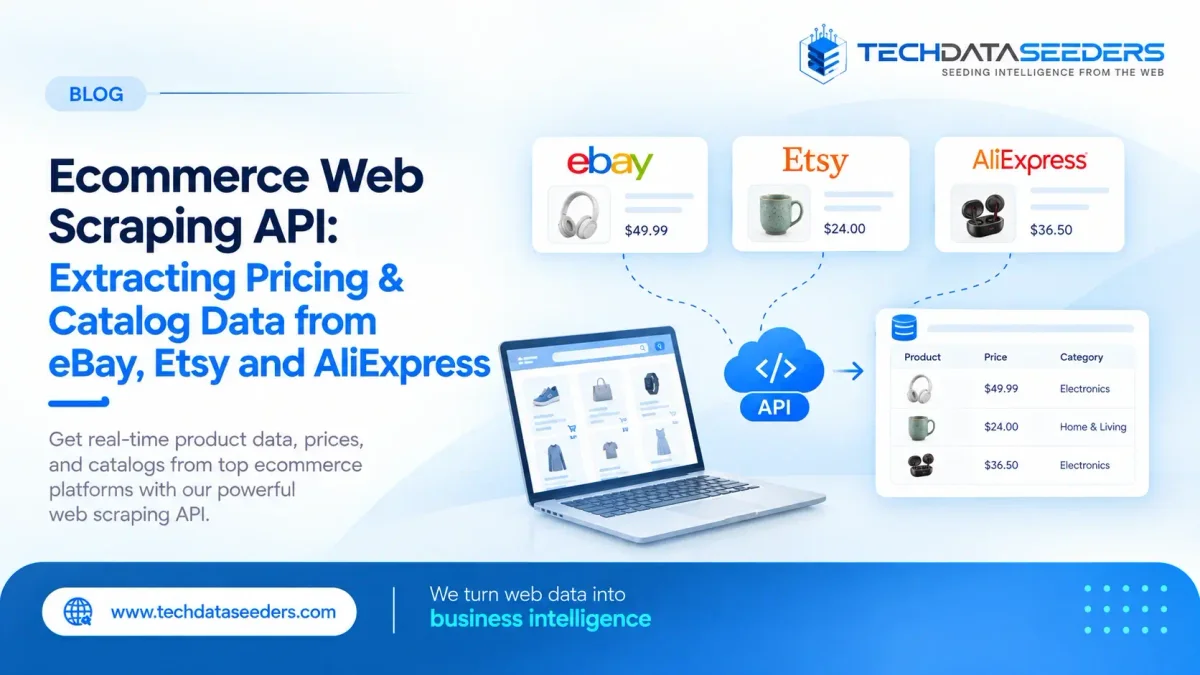
An Ecommerce Web Scraping API is an API-based Custom Data Extraction Services layer that allows applications to request structured information from e-commerce websites and marketplaces.
A simplified workflow looks like this:
- Marketplace
- Ecommerce Web Scraping API
- Data Processing
- Database / Dashboard / Analytics
Instead of building a separate extraction workflow for every source, businesses can use an API to integrate e-commerce data collection into their existing technology stack.
Depending on the project, the API can deliver fields such as:
- Product name
- Product URL
- Product ID or marketplace identifier
- Current price
- Original price
- Discount
- Product category
- Brand
- Seller information
- Product variations
- Ratings
- Reviews
- Availability
- Shipping information
- Images or image URLs
- Timestamp
An Ecommerce Web Scraping API becomes particularly useful when a business needs regular updates from multiple marketplaces rather than a one-time dataset.
Why Businesses Use Web Scraping Ecommerce Websites
There are thousands of e-commerce stores and marketplaces with constantly changing product information.
Businesses use Web Scraping Ecommerce Websites to answer questions such as:
- What are competitors charging?
- Which products are gaining popularity?
- Which categories are expanding?
- Where are products being discounted?
- Which products are unavailable?
- What products are competitors adding?
- How do different marketplaces price the same product?
- Which products have the strongest ratings?
- How does a competitor's catalog compare with ours?
For example, a consumer electronics brand could monitor several marketplaces to compare its products with competing brands with the help of E-commerce Data Scraping Services.
A retailer could track thousands of SKUs across different marketplaces and identify pricing gaps.
A market research company could collect product catalogs from multiple sources and build category-level intelligence.
The advantage of Web Scraping Ecommerce Websites is scale. Instead of manually reviewing individual listings, businesses can create a repeatable process for collecting the information they actually need.
What Data Can an Ecommerce Web Scraping API Extract?
The exact fields depend on the marketplace and project requirements, but a comprehensive e-commerce dataset may include several categories.
Product Data
- Product title
- Product description
- Brand
- Model
- Product ID
- Category
- Product attributes
- Variations
Pricing Data
- Current price
- Original price
- Discount
- Sale price
- Coupon information
- Currency
- Historical price
Seller Data
- Seller name
- Seller rating
- Seller location
- Number of offers
- Fulfillment information
Availability Data
- In-stock status
- Out-of-stock status
- Available quantity where exposed
- Delivery information
Customer Data
- Rating
- Review count
- Review information
- Rating distribution where available
This data can then be normalized so information from different marketplaces can be compared more easily.
Scrape Ecommerce Product Pricing Data for Competitive Analysis
One of the most common reasons businesses Scrape Ecommerce Product Pricing Data is competitor price monitoring.
Price changes can happen frequently, particularly in categories such as electronics, fashion, consumer goods, beauty products, and accessories.
A pricing dataset can capture:
| Data Point | Example |
|---|---|
| Product | Wireless Headphones |
| Marketplace | eBay |
| Current Price | $59.99 |
| Original Price | $79.99 |
| Discount | 25% |
| Seller | Example Store |
| Availability | In Stock |
| Timestamp | 2026-09-15 |
Once this information is collected repeatedly, businesses can create a historical pricing dataset.
That makes it possible to identify:
- Price increases
- Price reductions
- Promotional periods
- Competitor pricing patterns
- Average market prices
- Pricing gaps
- Category-level trends
When businesses Scrape Ecommerce Product Pricing Data, historical information is often more valuable than a single price snapshot because it provides context around every change.
eBay Data Scraping: Tracking Products, Sellers & Prices
eBay Data Scraping can help businesses collect structured information from eBay Browse API listings for competitive research, product intelligence, pricing analysis, and marketplace monitoring.
Depending on the use case and permitted access method, businesses may collect information such as:
- Item title
- Item ID
- Current price
- Shipping information
- Seller information
- Condition
- Category
- Availability
- Listing details
- Product variations
- Ratings and review-related information where available
eBay also provides an official Browse API that allows applications to search listings and retrieve detailed information about purchasable items, including seller, shipping, location, return-policy, and other listing details.
This creates an important distinction: businesses should use an official API where it provides the required data and access is available. Where a project requires broader web extraction, the collection method should be designed around the marketplace's applicable terms and access rules.
Why eBay Data Scraping Is Useful
A business selling electronics, for example, could monitor competing eBay listings to understand:
- Typical selling prices
- Number of competing listings
- Product availability
- Seller activity
- Price differences between new and used products
- Changes in marketplace assortment
This information can complement internal sales data and help businesses understand how their products are positioned within the marketplace.
Etsy Data Scraper: Collecting Marketplace Catalog Data
Etsy has a different marketplace structure, with a strong focus on handmade, vintage, personalized, craft, and niche products.
An Etsy Data Scraper can be designed to collect relevant listing information for market research, product discovery, competitive analysis, and catalog monitoring.
Depending Etsy Open API on the permitted data source and requirements, useful fields may include:
- Listing title
- Listing ID
- Product price
- Currency
- Category
- Tags
- Seller/shop information
- Listing status
- Product variations
- Images
- Reviews or ratings where available
- Inventory information where exposed
Etsy's Open API v3 provides documented access to listing resources and supports listing-related operations, with authentication and access scopes depending on the application.
This means businesses should first determine whether Etsy's official API can satisfy the required use case before considering other collection approaches.
What Can an Etsy Data Scraper Help Businesses Understand?
An Etsy Data Scraper can support research into:
- Popular product categories
- Price ranges
- Product assortment
- Competitor listings
- Product attributes
- Market gaps
- Emerging product trends
- Seller activity
For example, a business entering the personalized gifts category could compare thousands of relevant listings to understand pricing, product styles, personalization options, and category positioning.
AliExpress Product Price Scraping for Marketplace Intelligence
AliExpress contains a large range of products across categories and sellers, making it useful for businesses conducting product and pricing research.
AliExpress Product Price Scraping can be used to collect relevant pricing and catalog information for market analysis, product research, competitor monitoring, and sourcing intelligence.
Depending on the permitted access method, businesses may collect:
- Product title
- Product ID
- Current price
- Original price
- Discount
- Product variations
- Seller information
- Ratings
- Review count
- Product category
- Availability
- Shipping information
AliExpress also has an Open Platform/API ecosystem, but access and available data depend on the application, developer status, and approved use case. Businesses should use the official platform route when it covers their requirements.
Why AliExpress Product Price Scraping Matters
Historical pricing can help businesses identify whether a product is consistently priced at a certain level or frequently promoted.
For example:
Week 1: $18.99
Week 2: $18.99
Week 3: $15.99
Week 4: $18.49
Looking only at Week 3 could make the product appear cheaper than it normally is.
Historical AliExpress Product Price Scraping provides the additional context needed to distinguish regular pricing from temporary discounts.
Comparing eBay, Etsy and AliExpress Data
Each marketplace provides a different type of competitive signal.
| Marketplace | Useful Data | Common Business Use |
|---|---|---|
| eBay | Listings, prices, sellers, shipping, condition | Competitive pricing & marketplace research |
| Etsy | Listings, prices, categories, tags, shops | Product discovery & niche market research |
| AliExpress | Products, prices, sellers, variations | Product research & pricing intelligence |
An Ecommerce Web Scraping API can normalize information from these different sources into a common structure.
For example:
| Field | eBay | Etsy | AliExpress |
|---|---|---|---|
| Product Name | ✓ | ✓ | ✓ |
| Price | ✓ | ✓ | ✓ |
| Seller | ✓ | ✓ | ✓ |
| Category | ✓ | ✓ | ✓ |
| Availability | ✓ | ✓ | ✓ |
| Rating | Depending on source | Depending on source | Depending on source |
| Product Variants | ✓ | ✓ | ✓ |
This normalization is important because the same product may appear differently across marketplaces.
Product Matching Across Marketplaces
Collecting marketplace data is only half the job.
The next challenge is determining whether two listings actually represent the same product.
Consider:
eBay: "Wireless Bluetooth Headphones – Black – Model X100"
Etsy: "Black Wireless Headphones – Bluetooth Model X100"
AliExpress: "X100 Bluetooth Headset Black"
A simple title comparison may treat these as different products.
Product matching can instead consider:
- Brand
- Model number
- Product ID
- Product attributes
- Size
- Color
- Variant
- Pack quantity
- Technical specifications
- GTIN/UPC/EAN where available
Accurate product matching allows businesses to compare pricing and assortment across marketplaces without creating misleading comparisons.
How an Ecommerce Web Scraping API Fits Into a Data Pipeline
The API should not be viewed as the entire data system.
A scalable architecture can look like:
- eBay / Etsy / AliExpress
- Ecommerce Web Scraping API
- Data Extraction
- Validation & Cleaning
- Product Matching
- Database / Data Warehouse
- Analytics / Dashboard / AI / Pricing System
Each layer serves a different purpose.
Extraction: Collect relevant marketplace information.
Validation: Check for missing, duplicate, outdated, or abnormal values.
Normalization: Standardize currencies, product names, categories, units, and fields.
Product Matching: Connect equivalent products across marketplaces.
Storage: Maintain current and historical records.
Analytics: Turn the dataset into pricing, catalog, and competitive insights.
This separation makes the overall system easier to maintain as the number of marketplaces and products grows.
Ecommerce Web Scraping API vs Manual Data Collection
Manual research may work for a small product list.
It becomes much harder when the business needs to monitor:
- 10,000+ products
- Multiple marketplaces
- Hundreds of sellers
- Daily price changes
- Historical pricing
- Product availability
- Multiple geographic markets
An Ecommerce Web Scraping API can automate the repetitive extraction layer while allowing internal teams to focus on analysis.
| Manual Collection | API-Based Collection |
|---|---|
| Time-consuming | Automated |
| Difficult to scale | Easier to scale |
| Periodic snapshots | Scheduled updates |
| Higher manual effort | Programmatic access |
| Difficult to maintain history | Historical storage is easier |
| Limited marketplace coverage | Multiple sources can be integrated |
Automation doesn't remove the need for quality control. The extracted data still needs to be validated before it is used for pricing or business-critical decisions.
What Businesses Can Do With Marketplace Pricing & Catalog Data
Once data from eBay, Etsy, AliExpress, and other sources is structured, it can support several use cases.
Competitive Price Monitoring
Compare your prices against competing marketplace offers.
Product Research
Identify products, categories, and attributes gaining market attention.
Catalog Intelligence
Compare your assortment with competing marketplaces.
Market Research
Understand category size, price ranges, product variety, and seller activity.
Pricing Intelligence
Track historical pricing and identify market changes.
Product Opportunity Analysis
Identify categories or products where demand appears strong but competition is relatively limited.
Inventory Intelligence
Monitor product availability and recurring stock changes.
Marketplace Expansion
Evaluate a category before entering another marketplace.
This is where Web Scraping Ecommerce Websites becomes more than a data collection exercise. The objective is to turn marketplace information into business intelligence.
Data Quality Challenges in E-commerce API Extraction
A large dataset isn't necessarily a useful dataset.
Several issues need to be handled before marketplace data can support important decisions.
Price Formatting
Different marketplaces may use different currencies, decimal formats, or price structures.
Product Variations
One listing may contain several sizes, colors, or configurations with different prices.
Duplicate Products
The same product may appear multiple times under different listings.
Missing Fields
Some marketplaces may not expose the same information for every listing.
Changing Page Structures
When data is collected through web extraction, changes to the source website can affect the extraction process.
Data Freshness
A price collected yesterday may no longer represent the current market.
Product Matching
Similar titles don't always mean identical products.
A reliable Ecommerce Web Scraping API solution therefore needs extraction, validation, normalization, monitoring, and delivery—not just HTML collection.
How Techdataseeders Supports Ecommerce Data Extraction
Techdataseeders helps businesses collect, structure, and deliver e-commerce data from marketplaces, retailer websites, and digital commerce platforms.
Its e-commerce data capabilities cover product data, pricing, reviews, inventory, seller information, product matching, marketplace intelligence, custom APIs, and analytics.
For a marketplace-focused project, the workflow can be customized around:
- eBay data scraping
- Etsy marketplace data
- AliExpress product data
- Product catalog extraction
- Competitor price monitoring
- Historical pricing
- Product matching
- Availability monitoring
- Structured API delivery
- Scheduled data collection
How to Choose an Ecommerce Web Scraping API?
Before selecting an API or data provider, businesses should evaluate more than the number of websites supported.
1. Marketplace Coverage
Does the solution support the marketplaces that matter to your business?
2. Data Fields
Can it provide the exact product, pricing, seller, catalog, and availability fields you need?
3. Update Frequency
Can data be refreshed hourly, daily, weekly, or according to your business requirements?
4. Scalability
Can the solution handle thousands or millions of product records as your requirements grow?
5. Data Quality
How are missing, duplicate, inconsistent, or outdated records identified?
6. Product Matching
Can products from different marketplaces be mapped accurately?
7. Delivery Format
Can the data be delivered through JSON, CSV, database connections, APIs, feeds, or dashboards?
8. Historical Data
Can previous price and product observations be stored for trend analysis?
9. Customization
Can the extraction schema and workflow be adapted to your specific business requirements?
The right Ecommerce Web Scraping API should fit the actual Web Scraping APIs and simplify the data pipeline —not force the business to redesign its entire workflow around a generic output.
Final Thoughts
E-commerce marketplaces generate an enormous amount of product and pricing information every day.
For businesses competing across multiple marketplaces, manually tracking those changes isn't a sustainable way to maintain market visibility.
An Ecommerce Web Scraping API provides a scalable way to connect marketplace data with internal systems and collect structured information from sources such as eBay, Etsy, and AliExpress.
Whether the objective is to Scrape Ecommerce Product Pricing Data, perform eBay Data Scraping, use an Etsy Data Scraper, or conduct AliExpress Product Price Scraping, the real value comes from what happens after extraction.
When marketplace data is cleaned, matched, stored historically, and connected to analytics, it can support better pricing decisions, product research, catalog intelligence, competitive monitoring, and market expansion.
The goal isn't simply to collect more marketplace data.
It's to make that data useful.
FAQs
An Ecommerce Web Scraping API allows businesses and applications to collect structured product, pricing, catalog, seller, and availability data from e-commerce sources programmatically.
Businesses can collect current prices, original prices, discounts, product information, seller details, availability, and other relevant marketplace fields.
eBay Data Scraping can support competitor price monitoring, product research, seller analysis, marketplace intelligence, and catalog comparison.
Depending on the permitted data source, an Etsy Data Scraper can collect listing information such as titles, prices, categories, tags, seller details, variations, and availability.
AliExpress Product Price Scraping involves collecting relevant product pricing and related marketplace information for pricing analysis, product research, and competitive intelligence.
Yes. A properly designed API-based data pipeline can collect and normalize information from multiple e-commerce sources according to the project's requirements and permitted access methods.
It depends on the use case. Frequently changing pricing may require hourly or more frequent updates, while catalog research may only require daily or weekly collection.