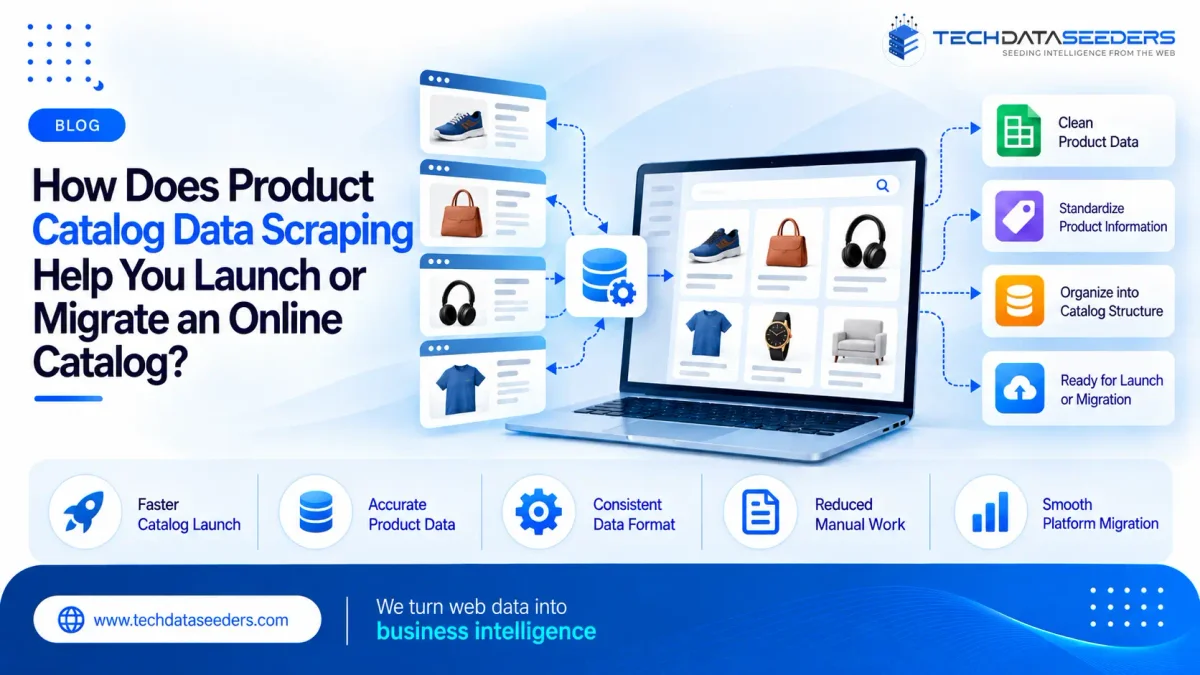
What Is Product Catalog Data Scraping?
Product Catalog Data Scraping is the process of collecting structured product information from ecommerce websites and transforming it into a usable dataset. The collected information can then be cleaned, mapped, and imported into a new ecommerce platform, marketplace, database, or internal catalog system. A detailed explanation of which is mentioned in the detailed ecommerce data scraping guide.
A typical product catalog dataset may include:
| Product Data | Examples |
|---|---|
| Product name | Product title or model name |
| SKU | Stock-keeping unit |
| Product ID | Website or marketplace identifier |
| Category | Category and subcategory |
| Description | Short and long descriptions |
| Price | Current or original price |
| Images | Product image URLs |
| Specifications | Size, material, dimensions, features |
| Availability | Stock or availability status |
| Variants | Size, color, configuration |
| Ratings | Average rating and review count |
| Product URL | Source product page |
The exact fields depend on the source website and the requirements of the new catalog.
How Does Product Catalog Data Scraping Help Launch a New Online Catalog?
Product Catalog Data Scraping can accelerate an ecommerce launch by turning existing online product information into structured catalog data. Instead of creating every product record manually, businesses can collect relevant information, standardize it, map it to the new platform's fields, and then review the dataset before importing it.
Building a Catalog From Existing Ecommerce Data
A new retailer may need to create hundreds or thousands of product records before launch. If similar product information already exists on an ecommerce website, scraping can provide a starting dataset for catalog creation.
The collected data can then be:
- Cleaned
- Categorized
- Deduplicated
- Mapped to required fields
- Validated
- Enriched where necessary
- Prepared for import
This makes ecommerce catalog data extraction useful when launching a new store or rebuilding an existing product database.
Creating a Consistent Product Structure
A new ecommerce data scraping for any platform may require specific fields for each product. Scraped information can be reorganized into a standard structure before it is imported.
For example:
Source website → Scraped data → Data cleaning → Field mapping → Validation → New catalog
This approach reduces the amount of manual catalog preparation required before launch.
How Does Product Catalog Data Scraping Support Ecommerce Catalog Migration?
Product Catalog Data Scraping can support catalog migration when product information needs to move from an existing website or legacy system into a new ecommerce platform. The scraping process can collect publicly displayed product information, while a separate transformation stage maps those fields to the destination platform.
Extracting Data From an Existing Ecommerce Website
When businesses migrate from an old ecommerce website, they may not always have a clean export containing every product attribute.
An Ecommerce Product Catalog Data scraper can collect available information from product pages and category pages, depending on the project requirements.
This can include:
- Product titles
- Descriptions
- SKUs
- Prices
- Images
- Product URLs
- Categories
- Variants
- Specifications
- Availability information
The resulting dataset can become part of the migration workflow.
Mapping Old Catalog Fields to New Fields
The source and destination platforms may use different field names or structures.
For example:
| Existing Catalog | New Catalog |
|---|---|
| Product_Name | Title |
| Product_Desc | Description |
| Product_Code | SKU |
| Main_Image | Image URL |
| Product_Type | Category |
| Sale_Price | Current Price |
This field mapping is an important part of ecommerce catalog data extraction because simply collecting the information does not make it ready for import.
What Data Can You Scrape From an Ecommerce Product Catalog?
Product Catalog Data Scraping can collect a wide range of product attributes, depending on what is available on the source pages and what the project requires.
Product Titles, Descriptions and Specifications
Businesses can Scrape Product data from E-commerce site pages to collect product names, descriptions, technical specifications, dimensions, materials, ingredients, compatibility information, and other visible attributes.
This information can help populate product detail pages on a new platform.
Product SKUs and Identifiers
SKUs, model numbers, product IDs, GTINs, UPCs, or other identifiers can help businesses organize product records and match products across systems.
Identifiers are particularly important during migration because they can help prevent duplicate products.
Product Images and Media Information
Product image URLs and associated image information may also be collected where appropriate.
For catalog migration, image data can be matched with the relevant product record so that the new catalog maintains its visual content structure.
Image usage rights should always be reviewed separately before reusing images on a new website.
Categories and Product Hierarchies
An ecommerce catalog may contain multiple levels:
Department → Category → Subcategory → Product
Collecting this hierarchy through automated product catalog scraping can help businesses understand how products are organized and recreate or redesign the structure on the destination platform.
How Does an Ecommerce Product Catalog Data Scraper Work?
An Ecommerce Product Catalog Data scraper typically follows a structured workflow that moves from source discovery to data delivery.
1. Identify Product and Category Pages
The first step is identifying the relevant ecommerce pages and determining which URLs contain product information.
2. Extract Product Attributes
The scraper collects the required fields from product and category pages.
3. Structure the Raw Data
Raw information is converted into structured records such as CSV, JSON, XML, database tables, or another required format.
4. Clean and Normalize the Dataset
Duplicate records, inconsistent formatting, missing values, and unwanted fields can be identified and handled.
5. Map Fields to the Destination Platform
The collected information is matched with the field structure required by the new ecommerce system.
6. Validate the Catalog
The final dataset can be checked for missing product fields, duplicate products, invalid values, broken image URLs, and other quality issues.
Why Is Automated Product Catalog Scraping Better Than Manual Collection?
Automated product catalog scraping can reduce repetitive manual work when businesses need to collect large numbers of product records. Manual copying becomes increasingly difficult as the catalog grows because it takes more time and can introduce inconsistent formatting or transcription errors.
Manual Product Collection vs Automated Scraping
| Factor | Manual Collection | Automated Product Catalog Scraping |
|---|---|---|
| Large catalogs | Time-consuming | More scalable |
| Data consistency | Depends on operator | Can follow defined rules |
| Repetitive work | High | Lower |
| Structured output | Requires manual formatting | Can be generated automatically |
| Updates | Difficult to repeat | Can be scheduled where appropriate |
| Validation | Often manual | Can be incorporated into workflow |
Automation does not eliminate the need for human review. Instead, it shifts human effort toward validation, mapping, and catalog decisions rather than repetitive copying.
What Is the Role of Ecommerce Catalog Data Extraction in Product Migration?
Ecommerce catalog data extraction provides the raw information needed to reconstruct or populate a product catalog. However, extraction is only one stage of a successful migration.
A useful migration workflow looks like this:
Source catalog → ecommerce catalog data extraction → cleaning → normalization → field mapping → validation → import
This distinction matters because a scraped dataset may contain information that does not directly match the destination platform.
For example, the old catalog may have a single "Product Details" field, while the new platform may require separate fields for:
- Material
- Size
- Color
- Brand
- Weight
- Dimensions
- Features
The transformation stage separates these attributes into the structure required by the new catalog.
How Can Product Catalog Data Scraping Handle Large Ecommerce Catalogs?
Large catalogs require more than simply increasing the number of pages being collected. A scalable Product Catalog Data Scraping workflow should consider URL discovery, extraction rules, processing, data storage, validation, and delivery.
Managing Thousands of Product URLs
A large catalog may contain thousands or millions of product URLs. The collection workflow should therefore distinguish between:
- Product pages
- Category pages
- Pagination pages
- Filter URLs
- Duplicate URLs
- Discontinued products
This helps prevent unnecessary collection and duplicate records.
Maintaining Consistent Data
When products have different page structures, extraction rules may need to accommodate variations without producing inconsistent datasets.
Standardized output fields make the resulting ecommerce catalog data extraction more useful for downstream migration and analysis.
How Should You Prepare Scraped Product Data Before Importing It?
Before importing the dataset, businesses should treat Product Catalog Data Scraping as part of a larger data preparation workflow rather than as the final step.
Remove Duplicate Records
Use product IDs, SKUs, URLs, or combinations of product attributes to identify potential duplicates.
Standardize Product Attributes
Normalize:
- Currency
- Units
- Product names
- Categories
- Attribute values
- Image URLs
- Formatting
Validate Required Fields
Check whether mandatory fields such as product name, SKU, ecommerce price, category, or image information are present.
Map Product Categories
Create a clear relationship between the old category structure and the destination catalog.
Check Product Variants
Make sure variants such as color and size remain associated with the correct parent product.
Review the Final Dataset
A sample or full validation pass can identify errors before the data reaches the live ecommerce platform.
How Techdataseeders Supports Product Catalog Data Scraping?
Techdataseeders can support Product Catalog Data Scraping projects by collecting structured ecommerce product information and preparing datasets for downstream business workflows.
Depending on project requirements, the workflow can cover product discovery, data extraction, structuring, cleaning, validation, and delivery.
For businesses launching or migrating an online catalog, the focus should be on producing usable product data rather than simply collecting large quantities of raw information.
Conclusion
Product Catalog Data Scraping can make ecommerce catalog launches and migrations more efficient by converting product information from existing online sources into structured, usable datasets. From product names and SKUs to descriptions, specifications, categories, prices, images, and variants, the collected information can be cleaned, mapped, validated, and prepared for a new ecommerce platform.
The most effective approach is to treat scraping as one part of the complete catalog workflow: extract → clean → normalize → map → validate → migrate.
FAQs
Product Catalog Data Scraping can reduce repetitive catalog entry by collecting product names, SKUs, descriptions, prices, categories, images, and specifications into a structured dataset. This can make ecommerce catalog data extraction a useful starting point for cleaning, mapping, and migrating products.
Yes. Businesses can Scrape Product data from E-commerce site pages when the collection is appropriate and complies with applicable laws, website terms, and data rights. The resulting information can support catalog research, migration, or new-store preparation.
An Ecommerce Product Catalog Data scraper can collect product titles, SKUs, prices, descriptions, categories, specifications, images, variants, availability, ratings, and URLs, depending on the source and project requirements.
Automated product catalog scraping can systematically process large numbers of product pages and organize the results into structured datasets. Extraction rules, validation, duplicate handling, and standardized fields help make large-scale Product Catalog Data Scraping more manageable.
Yes. Ecommerce catalog data extraction can include category hierarchies, parent products, variants, and attributes when that information is available on the source website. Proper field mapping is then needed to recreate the structure in the destination catalog.
After they Extract ecommerce product catalog data, businesses should clean duplicates, normalize attributes, map fields, validate required information, check variants and images, and prepare the dataset for import. This makes Product Catalog Data Scraping part of a complete migration workflow rather than just a collection step.
Yes. Product Catalog Data Scraping can support catalog enrichment by identifying missing descriptions, specifications, images, categories, or other product attributes. Combining automated product catalog scraping with existing catalog records can help businesses build more complete ecommerce datasets.