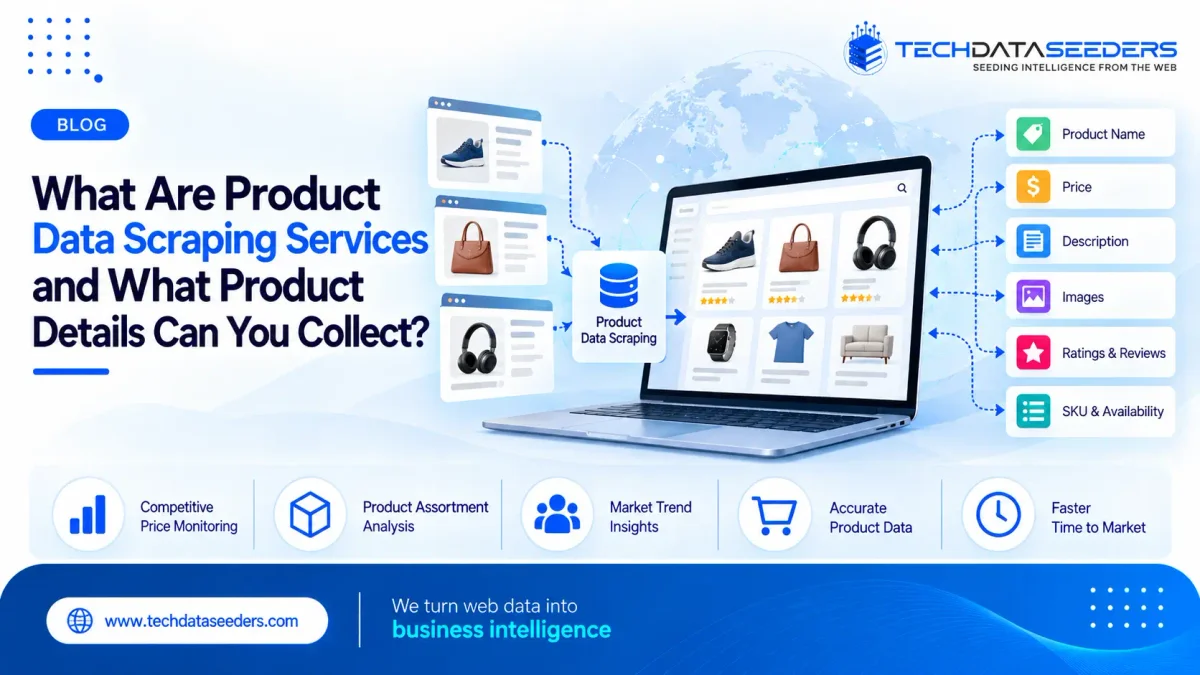
What Are Product Data Scraping Services?
Product Data Scraping Services are solutions that collect product-related information from online sources and convert it into structured, usable datasets. Instead of manually visiting thousands of product pages, businesses can define the fields they need and collect those fields across selected websites or marketplaces using the Ecommerce Web Scraping API.
Depending on the use case, a product dataset may include:
- Product name
- Product SKU
- Product ID
- Brand
- Category
- Product description
- Product specifications
- Price
- Discount
- Availability
- Seller information
- Ratings
- Review counts
- Product images
- Product URLs
- Breadcrumbs or category paths
The exact fields depend on the target websites and the business requirements.
Why Do Businesses Use Product Data Scraping?
Businesses may use product data scraping for:
- Competitor research
- Ecommerce catalog creation
- Product discovery
- Price monitoring
- Marketplace analysis
- Product comparison
- Catalog migration
- Inventory research
- Product intelligence
- Market research
The objective is not simply to collect as much information as possible. A useful scraping project focuses on collecting the right product fields in a consistent structure.
What Product Details Can You Collect Through Web Scraping Product Data?
Web scraping product data can capture a wide range of product attributes, from basic identifiers and descriptions to pricing, availability, images, specifications, and customer feedback. The fields collected should be selected according to how the resulting dataset will be used.
Product Names and Titles
Product names are among the most common fields collected.
A dataset may capture:
- Product title
- Short title
- Product subtitle
- Variant name
- Brand name
- Model name
Standardized product titles can make it easier to compare similar products across multiple websites.
Product Descriptions
Product descriptions can provide information about:
- Product features
- Materials
- Benefits
- Use cases
- Dimensions
- Technical details
For catalog analysis, descriptions can also be used to compare how different retailers present the same - product.
Product Categories
Product categories help businesses organize large datasets.
Depending on the website, collected category information may include:
- Main category
- Subcategory
- Product type
- Collection
- Breadcrumb path
This can help businesses analyze product assortment across retailers or marketplaces.
How Does Product SKU Scraping Help Ecommerce Businesses?
Product SKU scraping collects stock-keeping units and related product identifiers from online listings, helping businesses match products, organize catalogs, compare listings, and analyze inventory-related information. SKU data becomes particularly useful when a business needs to connect product information collected from different sources.
A SKU may be used alongside other attributes such as:
- Product name
- Brand
- Model
- Variant
- Price
- Availability
- Product URL
Why Are SKUs Important?
SKUs can help businesses distinguish between product variants that might otherwise look similar.
For example:
- Product A — Blue / Medium
- Product A — Blue / Large
- Product A — Black / Medium
Although the product name may be similar, different identifiers can help separate the individual variants.
Can Product SKU Scraping Support Product Matching?
Yes. SKU information can be one of several signals used for product matching.
However, not every retailer uses the same SKU structure. Businesses may therefore need to combine SKU information with:
- Brand
- Model number
- Product title
- UPC/EAN/GTIN
- Specifications
- Variant information
This creates a more reliable product-matching process.
What Is Product ID Extraction and Why Does It Matter?
Product ID extraction collects unique identifiers associated with product listings, allowing businesses to identify, organize, and track individual products across ecommerce data scraping sources. These identifiers may appear differently depending on the website or marketplace and can include internal product IDs, item IDs, listing IDs, model numbers, or other identifiers.
Product IDs can help with:
- Deduplicating records
- Tracking products over time
- Connecting product information
- Updating existing datasets
- Matching records across collection runs
Product IDs vs SKUs
A product ID and SKU are not necessarily the same thing.
A retailer may use an internal product ID to identify a listing while maintaining a separate SKU for inventory management.
Therefore, a structured dataset may store both fields when available.
| Field | Possible purpose |
|---|---|
| Product ID | Identifies a website or marketplace record |
| SKU | Identifies a stock-keeping unit |
| Model number | Identifies a manufacturer's product model |
| GTIN/EAN/UPC | Identifies a standardized product |
Keeping these identifiers separate can improve data quality and product matching.
How Does Ecommerce Product Information Scraping Work?
Ecommerce product information scraping collects selected product fields from ecommerce pages and transforms them into structured records that can be analyzed, compared, or integrated into business systems. The process generally involves identifying target pages, extracting required fields, cleaning the information, validating the results, and delivering the final dataset.
A typical workflow looks like this:
Target websites → Product discovery → Data extraction → Cleaning → Validation → Structured delivery
Product Discovery
The first step is identifying which products should be collected.
Depending on the project, product discovery may use:
- Category pages
- Search results
- Product URLs
- Sitemaps
- Marketplace listings
- Brand pages
Data Extraction
The required product attributes are collected from the relevant pages.
The extraction process may capture:
- Product information
- Pricing
- Specifications
- Images
- Ratings
- Availability
- Seller details
Data Cleaning
Raw ecommerce price tracking information can contain inconsistencies.
Cleaning may involve:
- Standardizing prices
- Removing duplicates
- Normalizing units
- Cleaning product titles
- Standardizing categories
- Formatting identifiers
Data Validation
Validation checks whether the collected information meets the required quality standards.
For example:
- Is the product URL valid?
- Is the price present?
- Does the SKU match the expected format?
- Is the product duplicated?
- Are required fields missing?
What Is Product Image Scraping?
Product image scraping collects publicly displayed product image URLs or image-related information from ecommerce pages, allowing businesses to organize visual product assets alongside other product attributes. Depending on the source and project requirements, businesses may collect primary images, additional gallery images, thumbnails, image URLs, or related metadata.
What Product Image Data Can Be Collected?
A product image dataset may contain:
- Main image URL
- Additional image URLs
- Thumbnail URL
- Image filename
- Image position
- Image-related metadata
For example:
| Product | Main Image | Additional Images |
|---|---|---|
| Product A | URL 1 | URL 2, URL 3 |
| Product B | URL 4 | URL 5, URL 6 |
Keeping image URLs connected to product IDs or SKUs makes the resulting catalog easier to manage.
What Are Product Images Used For?
Collected product image information may support:
- Catalog migration
- Product research
- Marketplace analysis
- Catalog comparison
- Product matching
- Ecommerce data enrichment
Businesses should also consider applicable copyright, licensing, and website-use restrictions before reusing collected images.
How Should You Structure a Product Data Scraping Project?
A successful product data scraping project starts by defining the required fields and target sources before extraction begins. Businesses should establish which products and websites matter, define the required output structure, decide how often data should be collected, and establish validation rules before scaling the project.
Step 1: Define the Required Product Fields
Create a field list such as:
- Product ID
- SKU
- Product name
- Brand
- Category
- Price
- Availability
- Description
- Specifications
- Images
- Ratings
Step 2: Select the Target Sources
Determine which websites, marketplaces, or product catalogs are relevant.
Step 3: Define Collection Frequency
Some datasets may only need periodic collection, while pricing or availability data may require more frequent updates.
Step 4: Establish Validation Rules
Decide how you will identify:
- Missing fields
- Duplicates
- Invalid identifiers
- Unexpected prices
- Product mismatches
Step 5: Choose the Delivery Format
Depending on your workflow, data can be delivered through:
- CSV
- Excel
- JSON
- Database
- API
- Data feeds
How Techdataseeders Supports Product Data Scraping Services?
Techdataseeders can support Product Data Scraping Services by collecting structured product information from relevant ecommerce sources and preparing the data for business use.
Depending on project requirements, the workflow can include:
Product discovery → Data extraction → Cleaning → Validation → Structuring → Delivery
The resulting dataset can support ecommerce research, competitive intelligence, catalog analysis, product comparison, price monitoring, and other data-driven workflows.
Techdataseeders can also support larger projects where businesses need product data delivered through structured files, databases, APIs, or other data pipelines.
Conclusion
Product Data Scraping Services give businesses a structured way to collect the product information they need from online sources. The data can go far beyond product names and prices, covering SKUs, product IDs, descriptions, specifications, images, availability, ratings, reviews, seller information, and other product attributes.
The most effective projects begin with a clear data requirement rather than trying to collect everything available. By defining the right fields, maintaining consistent product identifiers, validating the collected information, and preserving historical data where needed, businesses can turn web scraping product data into a reliable source of ecommerce intelligence.
FAQs for Product Data Scraping Services
Yes. Product Data Scraping Services can collect product names, prices, categories, descriptions, specifications, SKUs, images, availability, ratings, and other fields to create a structured ecommerce catalog. Businesses can combine this web scraping product data with their existing catalog to fill missing information and improve product records.
Yes. Product SKU scraping can help businesses identify and compare products across ecommerce websites. When combined with product IDs, model numbers, titles, and specifications, SKU information can support product matching and make Product Data Scraping Services more useful for maintaining consistent product datasets.
Product SKU scraping focuses on stock-keeping units, while product ID extraction captures identifiers used by a particular website or marketplace. Collecting both through Product Data Scraping Services can help businesses organize product records, reduce duplicates, track listings, and improve product matching across ecommerce sources.
Yes. Ecommerce product information scraping can collect specifications such as dimensions, materials, technical features, capacity, compatibility, ingredients, and other attributes displayed on product pages. Product Data Scraping Services can then structure these fields into datasets for product comparison, catalog enrichment, and ecommerce research.
Product image scraping can collect image URLs and related image information from product listings. When combined with other web scraping product data, these images can support catalog migration, product research, marketplace analysis, product matching, and catalog enrichment, subject to applicable image rights and usage restrictions.
Yes. Web scraping product data can provide information about competitor products, pricing, availability, specifications, categories, and promotions. Product Data Scraping Services can organize this information into structured datasets that businesses can analyze for competitive intelligence and product assortment research.
Yes. Product Data Scraping Services can be designed to collect information from multiple ecommerce websites and normalize the results into a consistent dataset. Combining product SKU scraping, product ID extraction, and ecommerce product information scraping can make cross-source product analysis more reliable.