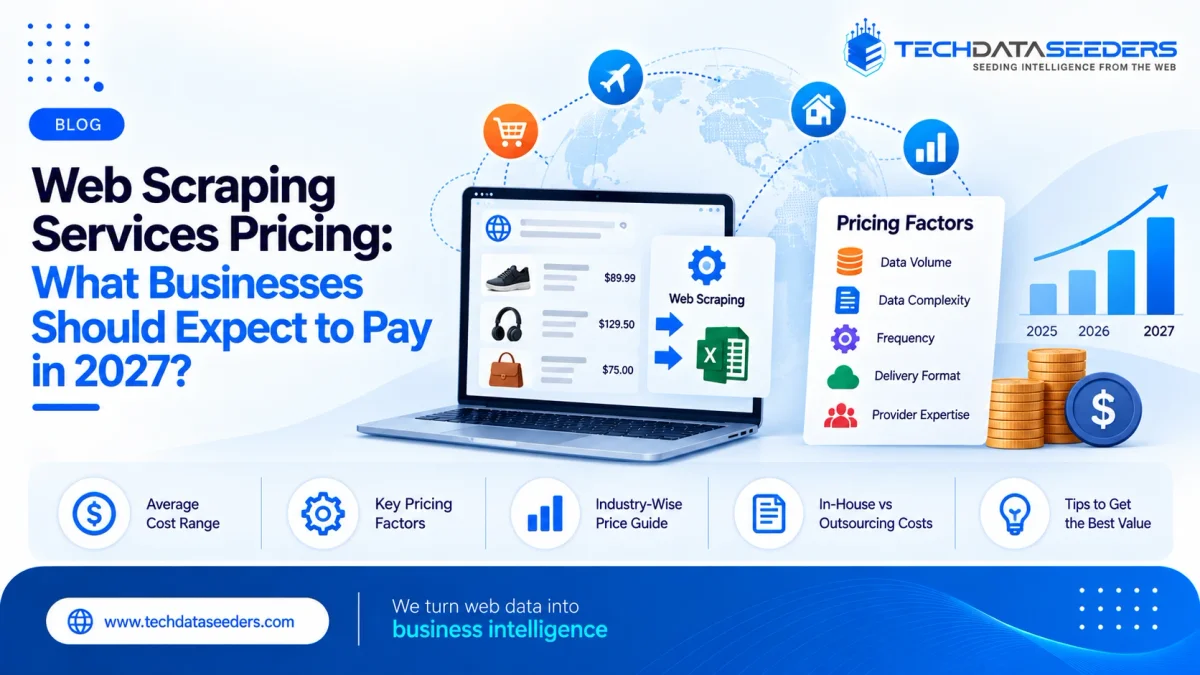
What Determines Web Scraping Services Pricing?
Web Scraping Services Pricing is mainly determined by the complexity of the data collection requirement rather than simply the number of pages scraped. Source count, website structure, data fields, collection frequency, data volume, geographic coverage, processing requirements, and delivery format can all affect the final cost of a web scraping project.
Number of Websites and Data Sources
Scraping information from one relatively consistent source is usually simpler than collecting data from hundreds of websites with different structures.
A project covering:
- 5 websites
- 50 websites
- 500 websites
can have very different infrastructure, maintenance, and monitoring requirements.
Website Complexity
Some websites have relatively predictable page structures, while others may contain frequently changing layouts, dynamic content, multiple product variations, or large catalogs.
This can increase development and maintenance effort.
Required Data Fields
The amount and type of information being extracted also matters.
For example, extracting only Product Name + Price is considerably different from collecting:
Product Name + SKU + Price + Discount + Rating + Reviews + Availability + Seller + Specifications + Images
More fields generally mean more extraction and validation logic.
How Does Web Scraping Service Cost Work?
Web scraping service cost usually reflects the complete data workflow rather than the extraction step alone. Businesses may be paying for source analysis, scraper development, infrastructure, data processing, validation, storage, monitoring, maintenance, and delivery, depending on how comprehensive the service needs to be.
A useful way to think about Web Scraping Services Pricing is:
Collection + Processing + Validation + Storage + Delivery + Maintenance
Not every project requires every component at the same level.
For example, a one-time research dataset may have limited infrastructure requirements, while a continuously updated enterprise dataset may require ongoing processing and monitoring.
One-Time vs Ongoing Requirements
A Real-time data feed api for a one-time extraction project and a recurring data collection service should not be evaluated using exactly the same pricing assumptions.
One-time project:
- Define sources
- Extract data
- Clean dataset
- Validate records
- Deliver final file
Ongoing project:
- Continuous collection
- Monitoring
- Data validation
- Historical storage
- Maintenance
- Scheduled delivery
The second model naturally involves more ongoing work.
What Are the Common Web Scraping Pricing Models?
Web scraping pricing models can be structured around different factors, including project scope, data volume, number of sources, collection frequency, or ongoing service requirements. The appropriate model depends on how predictable the workload is and whether the business needs a one-time dataset or continuously updated information.
Common approaches include:
| Pricing approach | Best suited for |
|---|---|
| Fixed project pricing | Clearly defined one-time projects |
| Per-page pricing | Simple, predictable extraction |
| Per-record pricing | Structured datasets with predictable volume |
| Data-volume pricing | Large-scale recurring datasets |
| Monthly service pricing | Continuous monitoring |
| Custom pricing | Complex enterprise requirements |
There is no single Web Scraping Services Pricing model that works for every business.
Fixed Project Pricing
A fixed project price can work when the scope is clearly defined.
For example:
100 websites → 20 specified fields → one-time extraction → CSV delivery
The more precisely the requirements are defined, the easier it is to estimate the project.
Recurring Pricing
For continuously updated data, businesses may prefer a recurring arrangement that covers regular collection, processing, maintenance, and delivery.
This is common when data needs to be refreshed daily, weekly, or at another defined frequency.
What Affects Custom Web Scraping Pricing?
Custom web scraping pricing depends on how much the solution needs to be tailored to the business requirement. Custom extraction logic, multiple data sources, complex schemas, specialized transformations, frequent collection, historical storage, APIs, and downstream integrations can all increase the scope compared with a basic scraping project.
Custom Data Requirements
A business may need fields that are not part of a standard dataset.
For example, an ecommerce company could require:
- Product variants
- Seller information
- Historical prices
- Promotional pricing
- Availability
- Ratings
- Review counts
- Category hierarchy
The more specialized the requirements, the more customization may be required.
Custom Delivery Requirements
The final delivery format can also affect the project.
Data might need to be delivered through:
- CSV
- JSON
- XML
- Database
- API
- Cloud storage
- Data feed
A business requiring direct system integration will generally have more requirements than one that only needs a downloadable dataset.
How Does Data Volume Affect Scraping Cost?
Data volume and scraping cost are closely connected because larger datasets generally require more collection, processing, storage, validation, and infrastructure capacity. However, volume alone does not determine Web Scraping Services Pricing. Collection frequency, source complexity, required fields, and processing requirements can be equally important.
For example:
Small Dataset: 10,000 product records collected once.
Medium Dataset: 500,000 records collected weekly.
Large Dataset: Several million records collected continuously across multiple marketplaces.
These projects have very different infrastructure and maintenance requirements even if they involve similar data fields.
Why Record Count Isn't Everything:
Two projects may both contain one million records but have very different requirements.
Project A
- 1 website
- Stable structure
- Weekly collection
- 5 fields
Project B
- 100 websites
- Different structures
- Daily collection
- 30 fields
- Product matching
- Historical storage
- API delivery
The second project can require substantially more engineering and operational effort.
How Does Scraping Frequency Affect Web Scraping Services Pricing?
The frequency of data collection can have a significant effect on Web Scraping Services Pricing because custom data api for collecting data once a month requires a very different operating model from collecting the same information every hour. Higher-frequency projects generally require more infrastructure, scheduling, processing, validation, monitoring, and data-delivery capacity.
For example:
| Frequency | Typical requirement |
|---|---|
| One-time | Research or project dataset |
| Monthly | Periodic market research |
| Weekly | Catalog or competitor monitoring |
| Daily | Pricing and availability |
| Multiple times daily | Fast-changing market information |
The right frequency should be based on how quickly the underlying information changes and how quickly the business needs to respond.
Web Scraping Project Cost: What Should Businesses Include?
Web Scraping Project Cost should be evaluated against the entire project scope rather than comparing a single extraction rate. Businesses should consider development, data sources, fields, volume, processing, validation, infrastructure, delivery, maintenance, and any required integrations before comparing different service proposals.
Before requesting a quote, define:
Data Requirements
What exactly needs to be collected?
Source Requirements
Which websites, marketplaces, apps, or other sources are involved?
Frequency
How often should the data be updated?
Volume
How many records or pages are expected?
Output
How should the final data be delivered?
Maintenance
Will the project run once or continuously?
These details make Web Scraping Services Pricing much easier to evaluate accurately.
What Should Businesses Look for in a Web Scraping Services Quote?
A good Web Scraping Services Pricing proposal should clearly explain what is included rather than providing only one headline number. Businesses should understand the expected data volume, sources, fields, collection frequency, validation, delivery method, maintenance responsibilities, and any assumptions that could change the final project scope.
Look for clarity around:
- Number of sources
- Number of data fields
- Expected data volume
- Collection frequency
- Data quality checks
- Delivery format
- Historical data requirements
- Maintenance
- Support
- API or database integration
This makes it easier to compare providers on actual deliverables, rather than simply comparing quoted prices.
Web Scraping Services Pricing in 2027: What Businesses Should Expect?
Web Scraping Services Pricing in 2027 is likely to remain highly dependent on project requirements rather than a universal industry rate. Businesses should expect pricing to vary according to source complexity, data volume, collection frequency, customization, processing, validation, infrastructure, and delivery requirements rather than assuming that every scraping project follows the same cost structure.
The most useful question isn't:
“How much does web scraping cost?”
It's:
“What does the business need the data pipeline to accomplish?”
That distinction helps businesses compare providers more effectively and build a realistic budget.
How Techdataseeders Approaches Web Scraping Services?
Techdataseeders can support businesses that require structured web data collection across different sources and use cases. Depending on the project, the workflow can include data extraction, processing, validation, structured delivery, analytics, APIs, and ongoing data collection. This allows Web Scraping Services Pricing to be evaluated according to the actual business requirements rather than a generic scraping rate.
Conclusion
Web Scraping Services Pricing in 2027 should be evaluated based on the complete data requirement rather than a simple per-page or per-record figure. Source complexity, data volume, collection frequency, customization, validation, infrastructure, and delivery can all influence the final investment.
For businesses, the best approach is to define the required dataset first, then compare providers based on data quality, reliability, scalability, maintenance, and total value alongside the quoted price.
FAQs for Web Scraping Services Pricing
Yes. Data that requires authentication, specialized access, or additional integration can involve a different project scope from publicly accessible information. Web scraping service cost depends on the technical and operational requirements involved, as well as the permitted access method and required data workflow.
Yes. The number and complexity of fields can influence Web Scraping Project Cost because additional fields may require more extraction logic, processing, normalization, and validation. However, field count should be considered alongside source complexity, data volume, and collection frequency when evaluating Web Scraping Services Pricing.
It can be more practical for recurring requirements, but there is no universal answer. Recurring web scraping pricing models can account for ongoing collection, maintenance, monitoring, and delivery, while separate projects may make more sense when the business only needs occasional datasets.
It can. Projects covering multiple regions may require additional domains, currencies, languages, product catalogs, or location-specific data handling. As a result, geographic coverage can influence custom web scraping pricing, particularly when businesses need consistent datasets across multiple international markets.
Yes. Starting with a limited set of sources or data fields can help businesses validate the usefulness of the dataset before expanding. A scalable approach can then accommodate greater data volume and scraping cost as more sources, records, or collection frequencies are added.
Provide the target websites, required data fields, estimated volume, collection frequency, geographic coverage, preferred output format, historical-data requirements, and intended use. These details give providers enough information to estimate Web Scraping Services Pricing more realistically.
Not necessarily. Custom web scraping pricing depends on the complexity and scope of the requirements. A custom solution can be more appropriate when a business needs specialized fields, workflows, integrations, or delivery formats that standard tools cannot provide efficiently.